Experimental Setup
Detection Concept & Kinematic Reconstruction
The R3B setup provides high-efficiency, high-resolution, and large-acceptance capabilities for kinematically complete measurements of reactions with relativistic radioactive beams. Measurements are exclusive or kinematically complete in the sense that all reaction products with velocities close to the beam velocity, as well as emitted gamma rays, are detected.
Relativistic secondary beams produced at the FRS / Super-FRS target are selected according to their magnetic rigidity and transported to the R3B experimental area. These secondary projectiles are uniquely identified on an event-by-event basis through energy-loss and time-of-flight measurements using dedicated detectors upstream of the reaction target.Particles produced through interactions between secondary projectiles and the target are measured using different detection systems depending on the scientific goal. For instance, the tracking and identification of heavy fragments require operating in a high-resolution mode, whereas tracking multi-particle decays demands high acceptance and multi-hit capabilities. Furthermore, high-rate experiments (~ 1 MHz) require detectors and readout electronics capable of handling such high particle flux.
Subsystem Tracking & Identification
To meet above diverse and demanding requirements, the R3B setup integrates a suite of specialized, state-of-the-art detection systems dedicated to measurements of different types of particles.
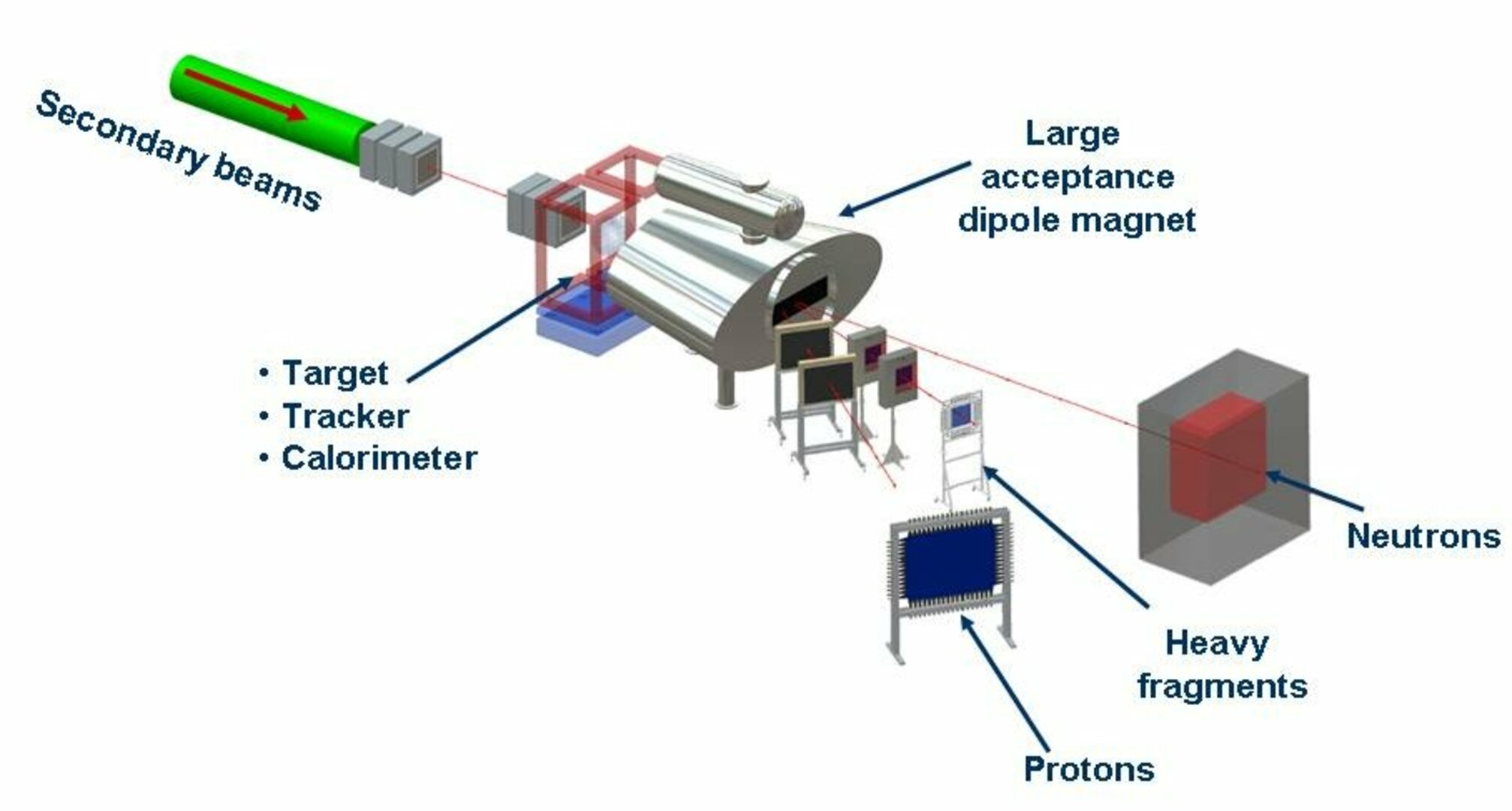
- Projectile Fragments: Their magnetic rigidity is determined from three position measurements defining their trajectories in the magnetic field of the large-acceptance GLAD dipole magnet downstream of the target. Additional energy-loss and time-of-flight measurements allow for unambiguous particle identification and momentum determination using detectors such as ToF wall, fiber detectors, and silicon detectors.
- Protons & Light Ions: For tracking protons and other light-charged particles with beam-like velocities, a proton-arm spectrometer based on scintillating fiber technology is utilized.
- Neutrons: Neutrons emitted from excited projectiles or projectile-like fragments are kinematically focused in the forward direction and detected with high efficiency in the NeuLAND detector. Their momenta are reconstructed from precise time-of-flight and position information.
- Gamma Rays & Recoil Particles: To minimize Doppler-broadening effects at high beam energies, gamma rays are detected with high angular resolution using CALIFA a versatile gamma-ray calorimeter, spectrometer, and also charged-particle detector. Light-charged particles from target interactions are tracked by dedicated target-recoil systems, offering a choice between an active target detector and a pixel-based detector depending on the reaction type.
These differet subsystems are shown in a figure below.
Transition to FAIR (Cave C to HEC)
During the construction phase of the FAIR facility, key components of the R3B setup were successfully developed, tested, and operated in Cave C at GSI, resulting in numerous peer-reviewed publications and PhD theses.
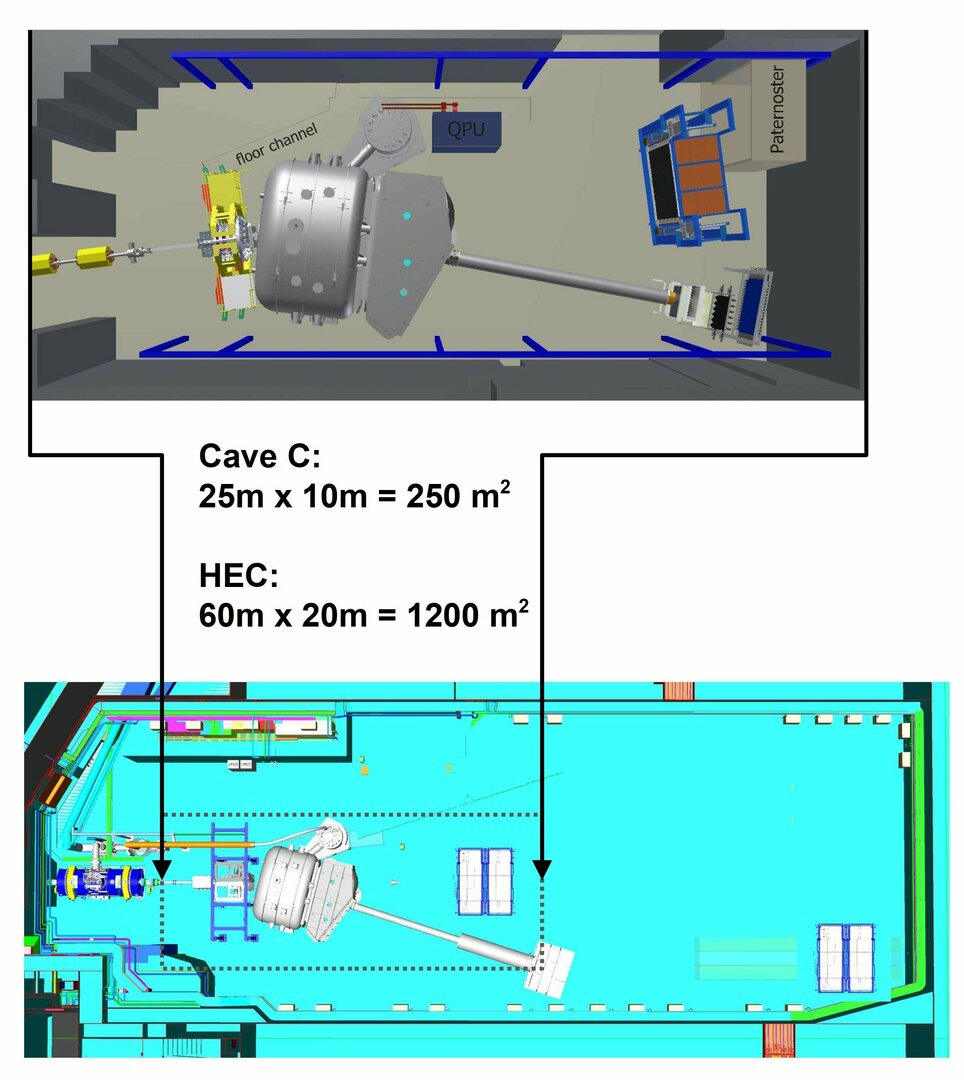
While these campaigns were highly successful, the physical constraints of Cave C will be overcome upon moving to the High-Energy Cave (HEC) at FAIR. HEC have a 4.8 larger surface as compared t Cave C (see figure below). The longer flight paths in HEC will significantly improve time-of-flight accuracy and particle identification resolution. Furthermore, the setup will benefit from an expanded detection sheme, including dedicated systems for light-charged particles, pions, and hypernuclei, alongside a high-resolution fragment spectrometer.