


Spatial and temporal DNA damage interaction
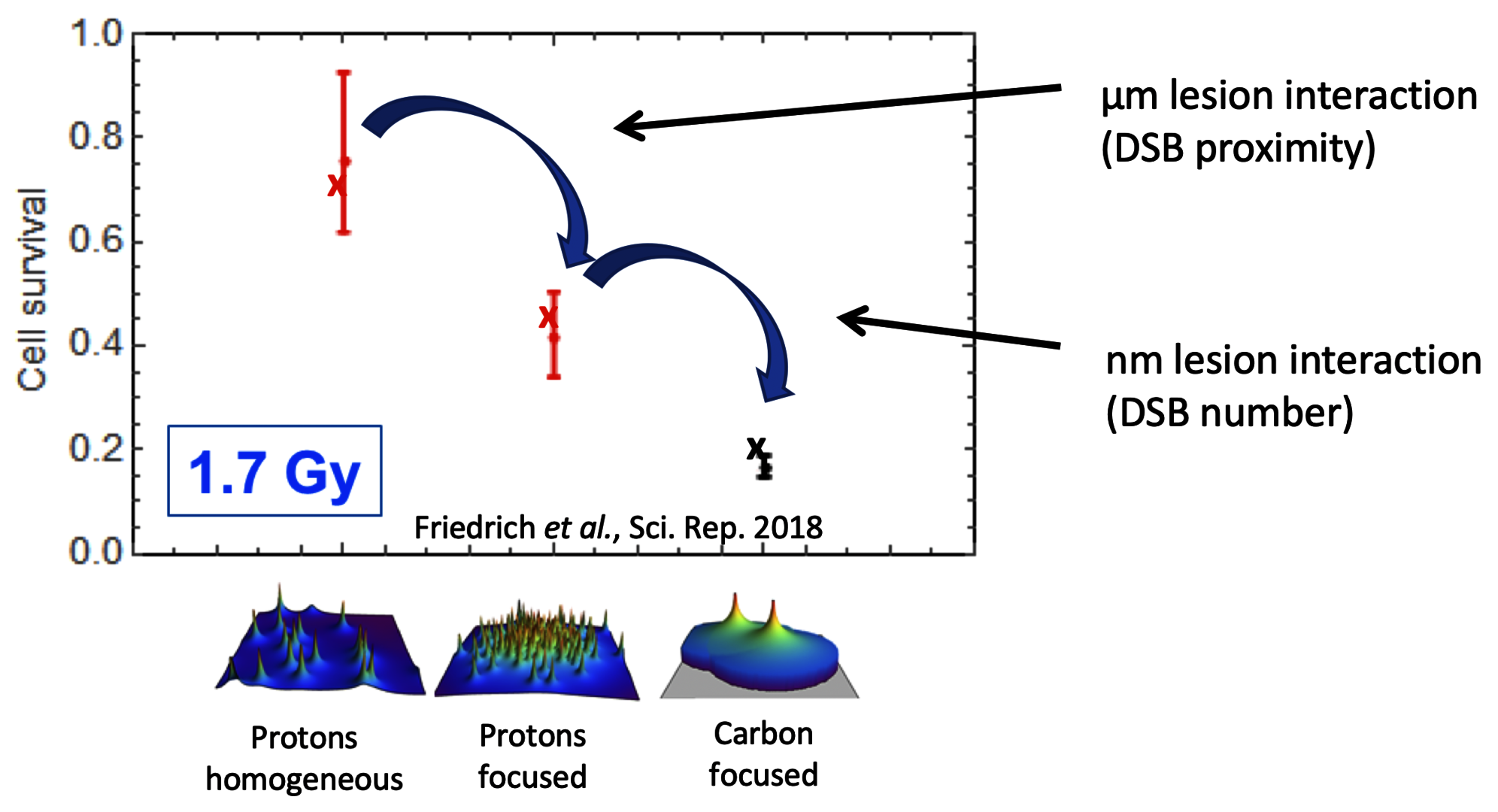
The DNA is the most radiosensitive biological target in cells, and in particular double strand breaks (DSB) have been identified as the most relevant type of DNA damage. Radiation induced DSB patterns are processed by a complex cascade of repair pathways and may ultimately result in cell death. We use the Local Effect Model (LEM) to model and investigate the connection between the early endpoint of DNA damage induction and the later endpoint of cell survival in dependence of LET and dose rate of the delivered radiation. Within the BMFTR founded Biomicro project we follow these question in close collaboration with experimental colleagues. As a focus, the joint spatial and temporal interaction of radiation induced DSB will be investigated.
Publications:
- Friedrich T, Ilicic K, Greubel C, et al. DNA damage interactions on both nanometer and micrometer scale determine overall cellular damage. Scientific Reports 8:16063 (2018). doi:10.1038/s41598-018-34323-9
- Scholz M. Effects of ion radiation on cells and tissues. In: Kausch H, et al., eds. Radiation Effects on Polymers for Biological Use. Advances in Polymer Science 162:1-14 (2003). doi:10.1007/3-540-45668-6_4
- Herr L, Friedrich T, Durante M, Scholz M. Investigation of the impact of temporal dose delivery patterns of ion irradiation with the local effect model. Radiation Research 201:275-286 (2024). doi:10.1093/radres/rrae004
- Tommasino F, Friedrich T, Scholz U, Taucher-Scholz G, Durante M, et al. A DNA double-strand break kinetic rejoining model based on the local effect model. Radiation Research 180:524-538 (2013). doi:10.1667/RR13389.1
Project contributors
Group Leader:
Dr. Thomas Friedrich
PhD Students:
M.Sc. Giuseppe Bevilacqua