Stellenangebote und Themen für Bachelor-/Master-Arbeiten
Postdoc Positionen
PhD Positionen
Themen für Bachelor-/Master-Arbeiten
Aufbau eines FROG Systems zur zeitlichen Charakterisierung des Laserpulsen an PHELIX und Erweiterung des Rekonstruktionsalgorithmus zur Berücksichtigung von räumlich-zeitlichen Effekte

Motivation:
Um die Wechselwirkung eines intensiven Laserstrahls mit Materie besser zu verstehen ist es notwendig die zugehörigen Parameter des Lasersystems genau zu kennen. Dazu gehört insbesondere eine Messung des zeitlichen Laserpuls-Profils. Als mögliche Methode für solche Charakterisierungen hat sich das Verfahren des „Frequency Resolved Optical Gating“ (FROG) bewährt, welches in der Lage ist sowohl die zeitliche Einhüllende des Pulses, als auch die zugehörige zeitliche Phase aus einer gemessenen „FROG-Spur“ zu bestimmen. Nach der Messung kann die zeitliche Pulsform mit Hilfe eines „Acousto-Optic Programmable Dispersive Filter“ (AOPDF) optimiert werden. Ziel des ersten Teils dieser Arbeit ist es daher einen FROG zu planen, für das PHELIX System aufzubauen und damit den zeitlichen Laserpuls zu Vermessen und zu Optimieren.
Diese Messungen werden allerdings durch Strahlaberrationen und die Kopplung zwischen räumlichen-zeitlichen Effekten erschwert, welche in großen Lasersystemen typischerweise auftreten. Daher ist das Ziel des zweiten Teils dieser Arbeit im bestehenden Rekonstruktionsalgorithmus genau solche Effekte zu berücksichtigen und potentiell zu optimieren.
Aufgaben B.Sc.:
- Planung und Aufbau des FROG Systems
- Kalibrierung des Systems durch Bild-Auswertung
- Einbau und Test am PHELIX System
- Optimierung des Laserpulses in einer Regelschleife
Zusätzliche Aufgaben M.Sc.:
- Erweiterung des bestehenden Rekonstruktionsalgorithmus unter Berücksichtigung von räumlich-spektralen Effekten
- Aufbau eines Test-Systems und Test des neuen Algorithmus mit kontrollierten räumlich-spektralen Effekten und Vergleich mit dem erwarteten Verhalten
- Untersuchung der Auswirkung von Strahlaberrationen auf die Pulsmessung und Pulsrekonstruktion
Ziele:
- Design, Aufbau und Kalibrierung eines FROGs
- Implementierung im System
- Erweiterung und Test des Rekonstruktionsalgorithmus
Nützliche Kenntnisse / Voraussetzungen:
- Optik und nichtlineare Effekte
- Programmierkenntnisse (LabVIEW, MATLAB oder Python von Vorteil)
Literatur:
- D. J. Kane and R. Trebino, "Characterization of arbitrary femtosecond pulses using frequency-resolved optical gating," in IEEE Journal of Quantum Electronics, vol. 29, no. 2, pp. 571-579, Feb (1993)
- S. Akturk, M. Kimmel, P. O’Shea, and R. Trebino, "Measuring spatial chirp in ultrashort pulses using single-shot Frequency-Resolved Optical Gating," Opt. Express 11, 68-78 (2003)
Bei Interesse an der Arbeit schreibe bitte eine Mail an:
Aufbau und Charakterisierung eines Gas-Systems für die laser-getrieben Beschleunigung von Elektronen
Aufbau und Charakterisierung eines Gas-Systems für die laser-getrieben Beschleunigung von Elektronen

Masterarbeit
Motivation:
Für Experimente im Bereich der Materie mit hoher Energiedichte wird häufig eine Röntgen- oder Gammastrahlungsquelle eingesetzt, um den Zustand der Materie zu detektieren. Diese Strahlung, bevorzugt mit einer kurzen Dauer und hoher Intensität, kann über hochenergetische Elektronen erzeugt werden. Ein Mechanismus zum Beschleunigen von Elektronen mittels eines Hoch-Intensität-Lasers ist die sogenannte „Self-Modulated Laser-Wakefield Acceleration“ (SM-LWFA), welche Targets mit einer relativ niedrigen Elektronendichte im Bereich von 1018 – 1019 cm-3 benötigt, allerdings mit einer großen räumlichen Ausdehnung im Bereich von mehreren Millimetern. Um ein solches Target, mit einem kontrollierbaren Dichteprofil, zu realisieren eignet sich ein sogenannter Gas-Jet, welcher über eine gepulste Düse, bei einem relativ hohen Druck bis zu 100 bar, erzeugt wird. Ziel dieser Arbeit ist die Simulation, Charakterisierung und die Inbetriebnahme eines solcher Gasdüsen für ein geplante Experimente am Hochenergielaser PHELIX.
Aufgaben:
- Aufbau eines Teststandes zur Charakterisierung der Eigenschaften des Gas-Jets
- Charakterisierung des Verhaltens der Düsen mittels Interferometrie
- Computational Fluid Dynamics (CFD) Simulationen von Gasdüsen
- Implementierung eines Rekonstruktionsalgorithmus für nicht-zylindersymmetrische Düsen und einer online-Rekonstruktion
- Betrieb der Gasdüsen, idealerweise während einer Experimentzeit an PHELIX
Ziele:
- Entwicklung eines Teststands für die Charakterisierung des Gasdüsen
- Einarbeitung in OpenFOAM und Simulation von neuartigen Spezialdüsen
Nützliche Vorkenntnisse:
- Grundlagen Optik
- Programmierkenntnisse (Python, LabView)
- Erfahrung mit Linux-basierten Systemen
- Erfahrung mit Gas-Systemen
- Idealerweise CFD Simulationskenntnisse mit OpenFOAM
Literatur:
- J. Nejdl et al., Rev. Sci. Instrum. 1 June 2019; 90 (6): 065107. doi.org/10.1063/1.5098084
- N. Lemos et al.,Plasma Phys. Control. Fusion 58 034018, DOI 10.1088/0741-3335/58/3/034018
Bei Interesse an der Arbeit schreibe bitte eine Mail an:
Bachelor-/Masterarbeit
Motivation:
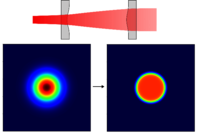
Obwohl Gaußförmige Strahlen hervorragende Eigenschaften für den Strahltransport haben, ist es in Hochenergielasersystemen üblich eine gleichmäßige räumliche Energieverteilung, ein sogenannte flat-top Strahl, zu nutzen. Das hat den Vorteil, dass z.B. Zerstörschwellen von Optiken erst bei höheren Energien erreicht werden und somit dieser Parameter maximiert werden kann. Eine weitere Anwendung ist die Nutzung eines solchen Strahlprofils für den Pumpstrahl eines optisch-parametrischen Verstärkers. Damit kann ein homogenerer Verstärkungsfaktor über das gesamte Strahlprofil erreicht werden was auch zu einer höheren Effizienz der Verstärkung führt.
Aufgaben:
- Design eines strahlformenden Teleskops mit den Kriterien:
- Design eines optischen Systems zur Umwandlung von Gaußstrahlen in Flattop-Strahlen und umgekehrt
- Simulation des Teleskops: Raytracing, Phasenberechnung, Strahlpropagation
- Festlegung der Strahlgrößen und der erlaubten Variation, mit zusätzlicher Abschätzung der Justageanfälligkeit
- Abschätzung der Abbildungsfreien Propagation des erzeugten Strahls
- Aufbau eines strahlformenden Teleskops und dessen Charakterisierung
- Effizienz
- Stabilität
- Restwelligkeit im Flattop
- Justageanfälligkeit
Ziele:
- Design und Aufbau eines strahlformenden Teleskops
- Charakterisierung des Teleskops
Nützliche Vorkenntnisse / Voraussetzungen:
- Optik und optisches Design
- Programmierkenntnisse zur Simulation und Analyse von Daten (z.B. Python, Matlab, Zemax…)
Literatur:
- https://www.spiedigitallibrary.org/conference-proceedings-of-spie/9626/96261W/Modular-optical-design-for-flexible-beam-shaping-of-a-top/10.1117/12.2191062.short
- https://iopscience.iop.org/article/10.1088/1742-6596/276/1/012171/pdf
Bei Interesse an der Arbeit schreibe bitte eine Mail an:
Bachelorarbeit
Motivation:
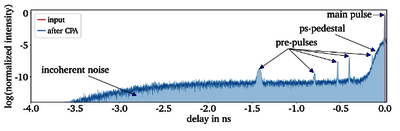
Mit dem Erreichen immer höherer Intensitäten ist die Messung und Optimierung des Zeitlichen Kontrasts eine der wichtigsten Aufgaben moderner Lasersysteme. Dabei spielen neben „quasi“-konstantem Hintergrundrauschen (Verstärkte Spontanemission), einer rapide ansteigenden Anstiegsflanke auch sogenannte Vorpulse eine Rolle. Da die zuvor genannten Störungen im zeitlichen Pulsprofil schon Plasmen erzeugen und damit Experimente unbrauchbar machen können ist eine Vermeidung essenziell. Insbesondere das Auftreten von Vorpulsen ist ein eher dynamischer Prozess, da schon leichte Veränderungen im System diese erzeugen können.
Aufgaben:
- Analyse bestehender Kontrastmessungen
- Berechnen der optischen Weglänge der existierenden Vor-/Nachpulse
- Abschätzen welche Optiken / optischen Systeme diese verursachen können
Ziele:
- Identifikation von Vor- und Nachpulsen im Lasersystem
- Eingrenzen der Entstehungsorte durch messen des Kontrastes an unterschiedlichen Stellen im System
Nützliche Vorkenntnisse / Voraussetzungen:
- Grundlagen der Optik
- Programmierkenntnisse zur Datenanalyse (z.B. Python)
Literatur
- https://link.springer.com/article/10.1007/s00340-019-7172-5
- https://www.cambridge.org/core/journals/high-power-laser-science-and-engineering/article/enhancement-of-prepulse-and-picosecond-pedestal-contrast-of-the-petawatt-jkarenp-laser/FD2BF3EAEFA3AC0ED82D7E49C8B87CE8
Bei Interesse an der Arbeit schreibe bitte eine Mail an:
Internships
Internships for master students and PhD student positions are offered regularly in the department.
For the latest offers please send your resumes and a short motivation email to Prof. V. Bagnoud.