Postdoc Positionen
Setup of a FROG system for the temporal characterization of the laser pulses at PHELIX and extension of the reconstruction algorithm for the consideration of spatio-temporal effects

Motivation:
To better understand the interaction of an intense laser beam with matter it is necessary to know the parameters of the laser system. In particular, this this includes a measurement of the temporal laser pulse profile. The method of "Frequency Resolved Optical Gating" (FROG) has proven itself as a possible way for such characterizations, which is able to reconstruct both the temporal envelope of the pulse and the corresponding temporal phase from a measured "FROG trace". After the measurement, the temporal pulse shape can be optimized with the aid of an "Acousto-Optic Programmable Dispersive Filter" (AOPDF). The aim of the first part of this work is therefore to plan a FROG, set it up at the PHELIX system and use it to measure and optimize the temporal laser pulse.
These measurements are complicated by beam aberrations and the coupling between spatio-temporal effects, which typically occur in large laser systems. Therefore, the aim of the second part of this work is to consider and potentially optimise precisely such effects in the existing reconstruction algorithm.
Tasks B.Sc.:
- Planning and design of the FROG system
- Calibration of the system by image analysis
- Commissioning and testing on at PHELIX system.
- Optimisation of the laser pulse in a control loop with an AOPDF (Acousto-Opti Porgrammable Dispersive Filter)
Additional tasks M.Sc.:
- Extension of the existing reconstruction algorithm under consideration of spatial-spectral effects
- Test of the new algorithm with controlled spatial-spectral effects and comparison with the expected behavior
- Investigation the effect of beam aberrations on pulse measurement and pulse reconstruction
Goals:
- Design, setup and calibration of the a FROG
- Implementation of the device in the system
- Extension and test of the reconstruction algorithm
Useful prior knowledge / prerequisites:
- Knowledge on optics and nonlinear effects
- Programming skills (e.g. LabVIEW, MATLAB or Python are of advantage)
Literature:
- D. J. Kane and R. Trebino, "Characterization of arbitrary femtosecond pulses using frequency-resolved optical gating," in IEEE Journal of Quantum Electronics, vol. 29, no. 2, pp. 571-579, Feb (1993)
- S. Akturk, M. Kimmel, P. O’Shea, and R. Trebino, "Measuring spatial chirp in ultrashort pulses using single-shot Frequency-Resolved Optical Gating," Opt. Express 11, 68-78 (2003)
If you are interested in this work please send a mail to:
Setup and characterization of a gas system fort he laser-driven acceleration of electrons

Master's thesis
Motivation:
For experiments in the field of matter with high energy density, an x-ray or gamma radiation source is often used to detect the state of matter. This radiation, preferably of short duration and high intensity, can be generated using high-energy electrons. One mechanism for accelerating electrons using a high-intensity laser is the so-called "Self-Modulated Laser Wakefield Acceleration" (SM-LWFA), which requires targets with a relatively low electron density in the range of 1018 - 1019 cm-3, but with a large spatial expansion in the range of several millimeters. In order to realize such a target with a controllable density profile, a so-called gas jet is suitable, which is generated via a pulsed nozzle at a relatively high pressure of up to 100 bar. The aim of this work is the simulation, characterization and commissioning of such gas nozzles for planned experiments at the PHELIX high-energy laser.
Tasks:
- Construction of a test stand to characterize the properties of the gas jet
- Characterization of the nozzle behavior by means of interferometry
- Computational Fluid Dynamics (CFD) simulation of gas-nozzles
- Implementation of a reconstruction algorithm for non-cylindrical nozzles and an online reconstruction
- Commissioning of the gas nozzles, ideally during an experiment period at PHELIX
Goals:
- Developed a test bench for the characterization of gas nozzles
- Introduction to OpenFOAM and Simulation of novel specialized nozzles
Useful prior knowledge / prerequisites:
- Knowledge on optics
- Experience in programming (e.g. Python, Matlab…)
- Experience with Linux-based systems
- Knowledge with gas systems
- Ideally knowledge on CFD simulations with OpenFOAM
Literature:
- J. Nejdl et al., Rev. Sci. Instrum. 1 June 2019; 90 (6): 065107. doi.org/10.1063/1.5098084
- N. Lemos et al.,Plasma Phys. Control. Fusion 58 034018, DOI 10.1088/0741-3335/58/3/034018
If you are interested in this work, please write a mail to:
Bachelor-/Masterthesis
Motivation:
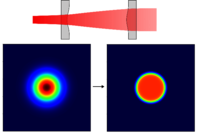
Although Gaussian beams have excellent properties for beam transport, it is common practice in high-energy laser systems to use a uniform spatial energy distribution, a so-called flat-top beam. This has the advantage that, for example, the damage thresholds of optics are only reached at higher energies and this parameter can therefore be maximised. Another application is the use of such a beam profile for the pump beam of an optical parametric amplifier. This allows a more homogeneous amplification factor to be achieved over the entire beam profile, which also leads to higher amplification efficiency.
Tasks:
- Design of a beam-forming telescope with the following criteria:
- Design of an optical system for converting Gaussian beams into Flattop beams and vice versa
- Simulation of the telescope: ray tracing, phase calculation, beam propagation
- Determination of the beam sizes and the permitted variation, with additional estimation of the susceptibility to adjustment
- Estimation of the image-free propagation of the generated beam
- Design of a beam-forming telescope and its characterization:
- Efficiency
- Stability
- Residual ripple in the flattop
- susceptibility to adjustment
Goals:
- Design and construction of a beam-forming telescope
- Characterization of the telescope
Useful prior knowledge / prerequisites:
- Optics and optical design
- Programming skills for modeling and analysis of generate data (e.g. Python, Matlab, Zemax…)
Literatur:
- https://www.spiedigitallibrary.org/conference-proceedings-of-spie/9626/96261W/Modular-optical-design-for-flexible-beam-shaping-of-a-top/10.1117/12.2191062.short
- iopscience.iop.org/article/10.1088/1742-6596/276/1/012171/pdf
If you are interested in this work, please write a mail to::
Bachelorthesis
Motivation:
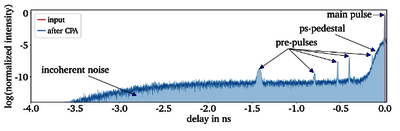
With the achievement of ever higher intensities, the measurement and optimisation of the temporal contrast is one of the most important tasks of modern laser systems. In addition to "quasi"-constant background noise (amplified spontaneous emission) and a rapidly increasing rising edge, so-called prepulses also play a role. Since the aforementioned disturbances in the temporal pulse profile can already generate plasmas and thus render experiments unusable, it is essential to avoid them. The occurrence of prepulses in particular is a rather dynamic process, as even slight changes in the system can generate them.
Tasks:
- Analysis of existing contrast measurements
- Calculate the optical path length of existing pre- and post-pulses
- Estimate which optics / optical systems can cause these
Goals:
- Identification of pre- and post-pulses in the laser system
- Localization of the points of origin by measuring the contrast at different points in the system
Useful prior knowledge / prerequisites:
- Basics of optics
- Programming skills for data analysis (e.g. Python)
Literature:
- https://link.springer.com/article/10.1007/s00340-019-7172-5
- https://www.cambridge.org/core/journals/high-power-laser-science-and-engineering/article/enhancement-of-prepulse-and-picosecond-pedestal-contrast-of-the-petawatt-jkarenp-laser/FD2BF3EAEFA3AC0ED82D7E49C8B87CE8
If you are interested in this work, please write a mail to: