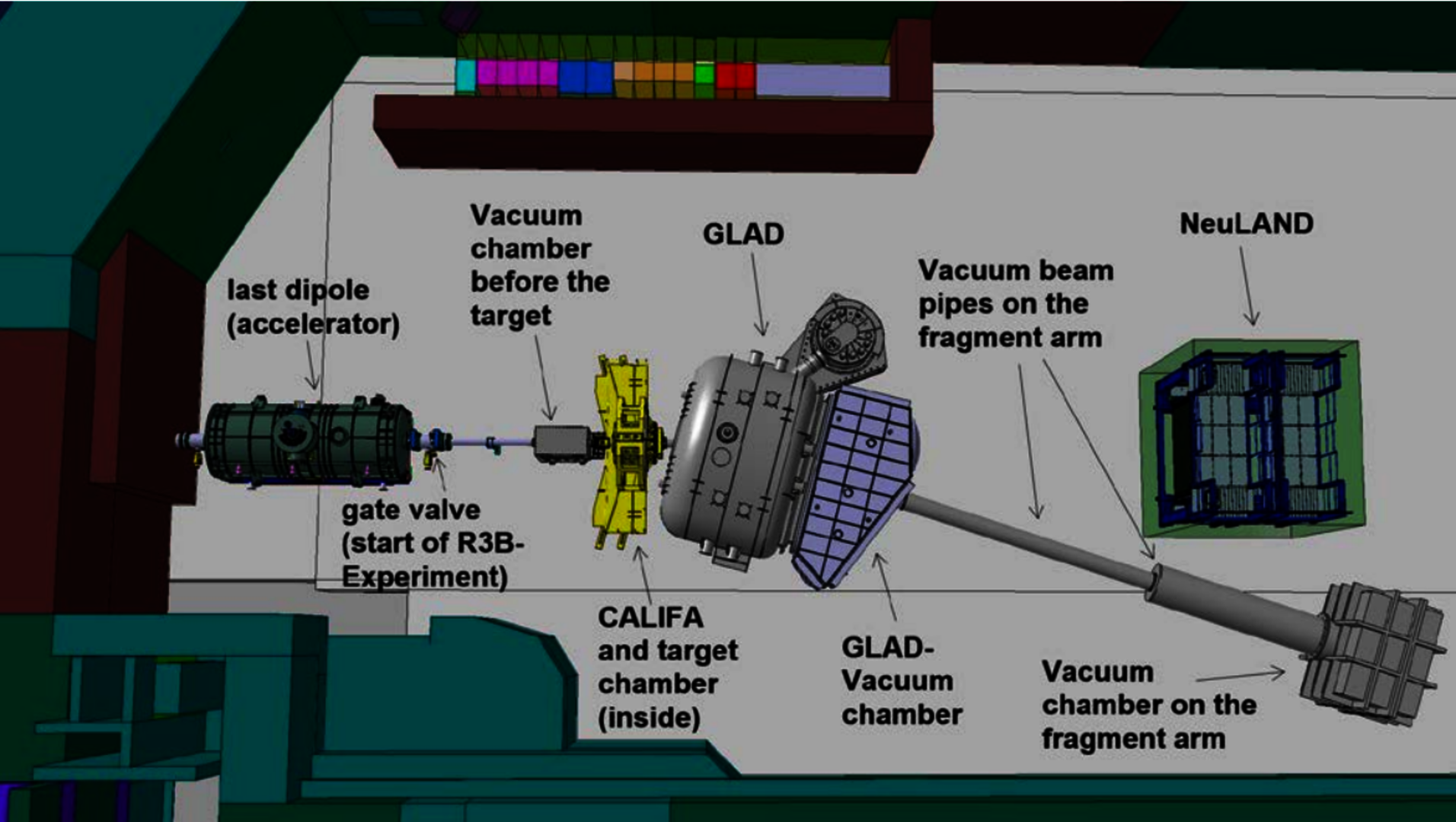
R3B setup in High-Energy Cave at FAIR
Contact person: Daniel Körper
Overview of the High-Energy Cave (HEC)
The High-Energy Cave (HEC) is situated at the final focal plane of the new Super-FRS fragment separator at FAIR. Relativistic, fully stripped, short-lived isotopes with energies up to 1.5AGeV and nuclear charges up to Z = 92 will be produced at the production target of the Super-FRS. Secondary ions of interest are selected by the separator, delivered to HEC with a momentum resolution on the order of 10-4 at a maximum beam rigidity of 20 Tm, and identified on an event-by-event basis. Products of their interactions with different targets will be studied using the R3B experimental setup.
Upgrades Compared to Cave C
Compared to the Phase-0 setup operated in Cave C, the installation in HEC introduces several major enhancements:
- Enhanced Resolution: Longer flight paths in HEC significantly improve time-of-flight accuracy and particle identification resolution.
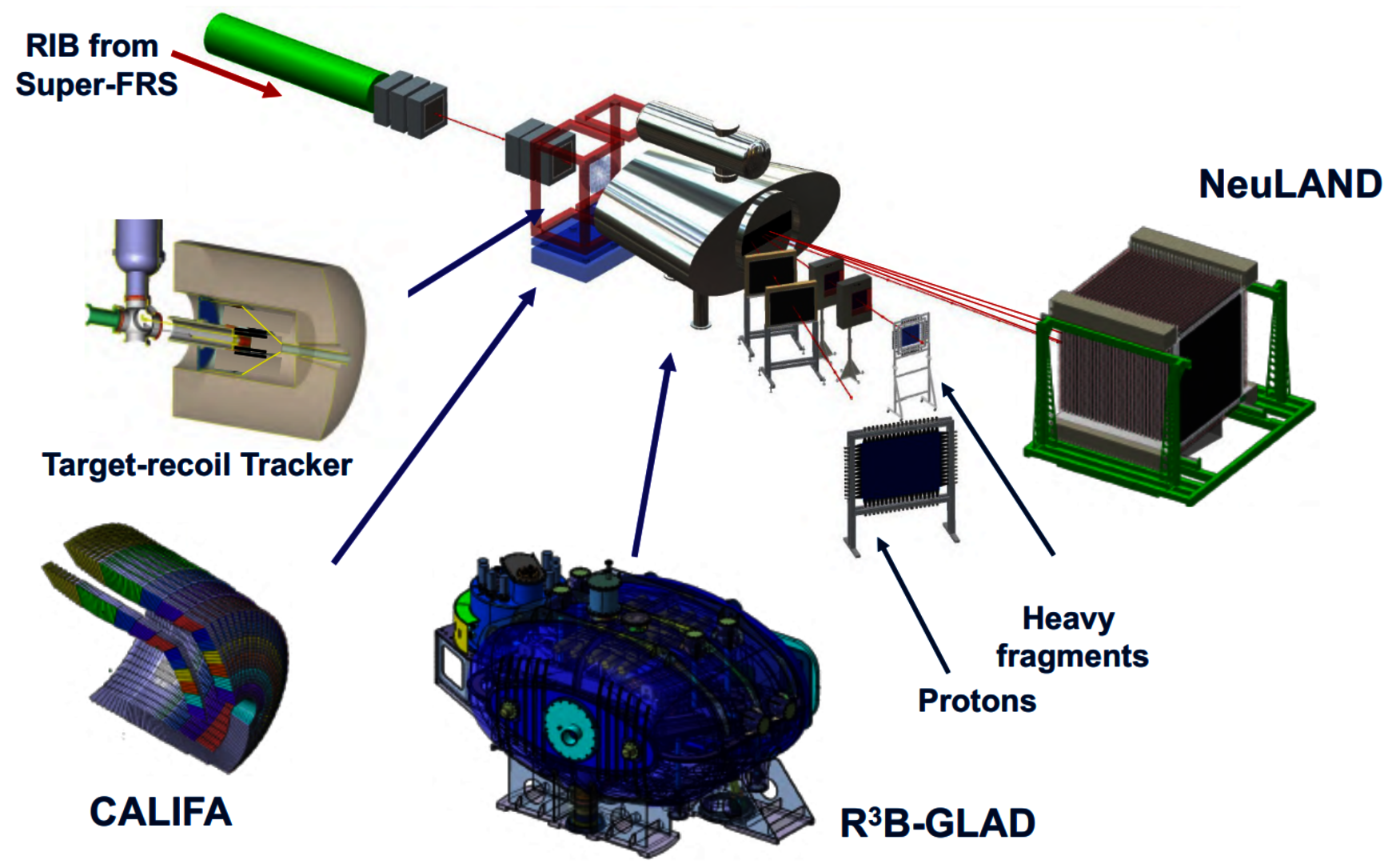
- Expanded Detection Capability: The setup features dedicated systems for tracking light-charged particles, pions, and hypernuclei, alongside a high-resolution fragment spectrometer.
- Increased Efficiency: CALIFA and NeuLAND will be fully equipped with their complete detector modules, considerably increasing overall detection efficiencies.
A schematic view of the R3B experimental setup in HEC is shown in the figure below, while description of different subsystems can be found here.
The relocation of the setup from Cave C to HEC began in 2026, marked by the transfer and positioning of the large GLAD vacuum chamber as the initial major milestone.
Dedicated Infrastructure
To guarantee reliable operation of the R3B setup and enable seamless integration of future devices, novel and upgraded infrastructure systems are being established at HEC. Key additions that were not available in Cave C include:
- Rail System: A sophisticated rail system positioned in front of the GLAD magnet to enable rapid positioning and exchange of specific detector modules.
- Auxiliary Crane: An additional crane installed directly above the reaction-target area to facilitate heavy hardware handling.
- Cross-Laser Alignment: A self-leveling cross-laser alignment system for fast and precise detector positioning.
- Laser Scanning & Tracking: Advanced laser tracking and scanning systems to accurately map detector geometries and spatial coordinates.
- Cryogenic Connectivity: Specialized interfaces to connect GLAD directly to the main Super-FRS helium-cryogenics supply.
- Cooling Infrastructure: A dedicated heat-exchange station providing regulated cooling water and distribution piping across the experimental cave.
Detailed specifications of individual components are documented in the dedicated R3B Infrastructure Technical Design Report.
High-Vacuum System
Another critical element of the HEC setup is the dedicated vacuum system. Many physics campaigns require continuous operation at pressures below 10-5 mbar to perform precision measurements of reaction products along flight paths virtually free of background scattering centers. The system comprises custom vacuum chambers, turbomolecular and backing pumps, and standardized flange connections designed for universal use across all HEC experiments.Standard components of the vacuum system are shown in the figure below.
Further details on the vacuum architecture can be found in the R3B Vacuum System Technical Design Report.