


Tumor Hypoxia and new ions for particle therapy
In clinical radiotherapy, hypoxia is a hallmark of locally advanced solid tumors. Hypoxic tumor cells are highly radioresistant and are often responsible for local recurrences, as well as serving as a source of cancer stem cells, disseminated tumor cells, and metastases, leading to poor prognosis. Reduced radiosensitivity in hypoxic conditions was first demonstrated as early as 1921.The sensitizing effect of oxygen can only be observed when oxygen is present during irradiation, and its magnitude depends on oxygen concentration. At oxygen levels above 3%, the full sensitizing effect is observed, whereas at lower concentrations, particularly between 1% and 0.1%, radiosensitivity sharply decreases (Oxygen Enhancement Ratio, OER). High-LET radiation, such as carbon-ion therapy, offers the potential to reduce the OER and more effectively inactivate hypoxic tumor cells (figure 4).
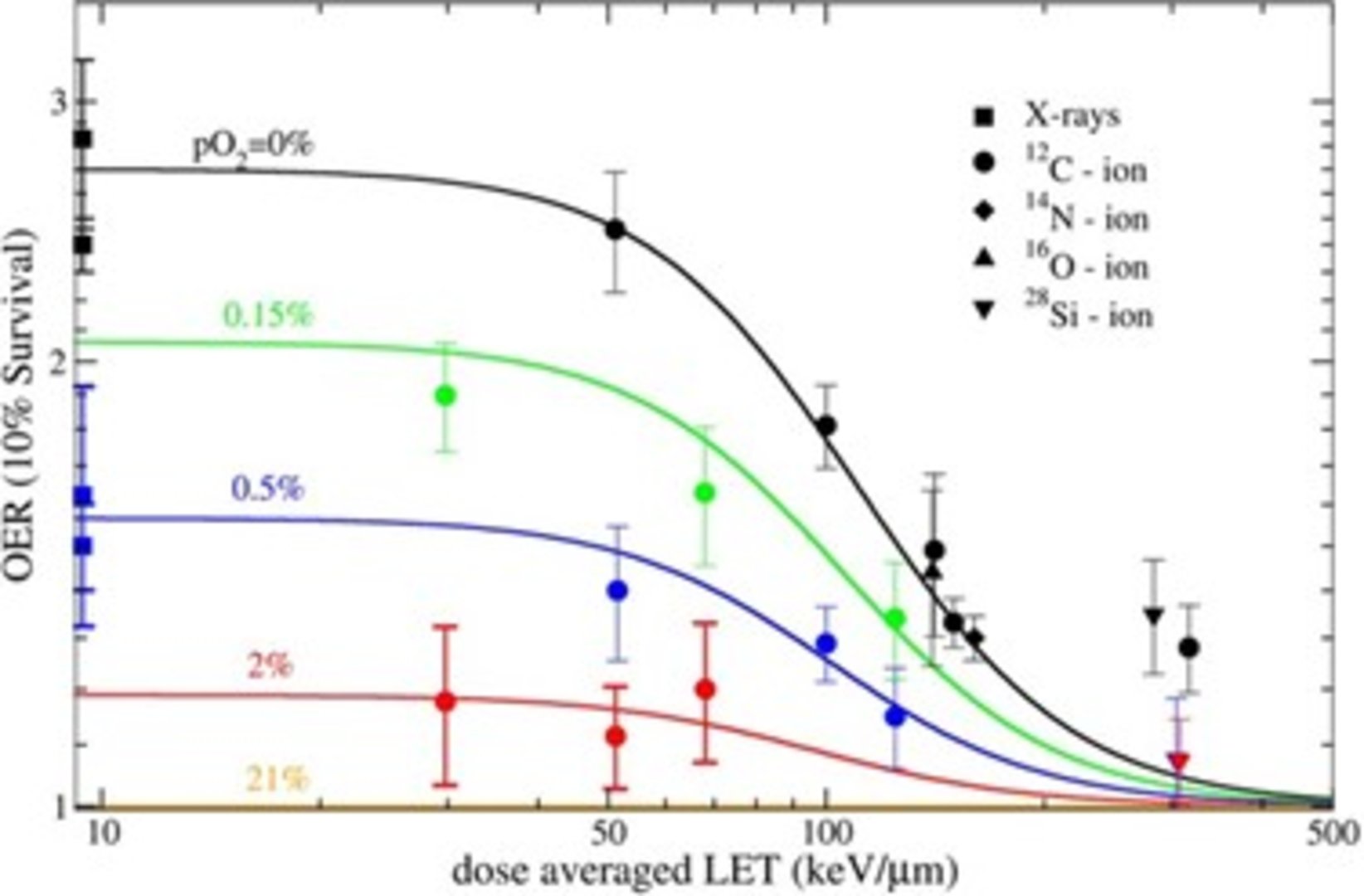
Figure 4: Collection of OER measurements as a function of dose-averaged LET at different oxygen concentrations.Tinganelli W, Durante M, Hirayama R, Kraemer M, Maier A, Kraft-Weyrather W, Furusawa Y, Friedrich T, Scifoni E. Kill-painting of Hypoxic tumorus in charged particle therapy. Sci Rep. 2015; 5: 17016.
In our lab, we are investigating the potential use of new ions, in addition to carbon ions, for therapeutic applications.