


Space radiation physics
Group leader: Dr. Christoph Schuy
The Space Radiation Physics Group investigates the effects of space radiation and develops strategies to protect astronauts and critical technologies, addressing one of the major challenges of human and robotic space exploration.
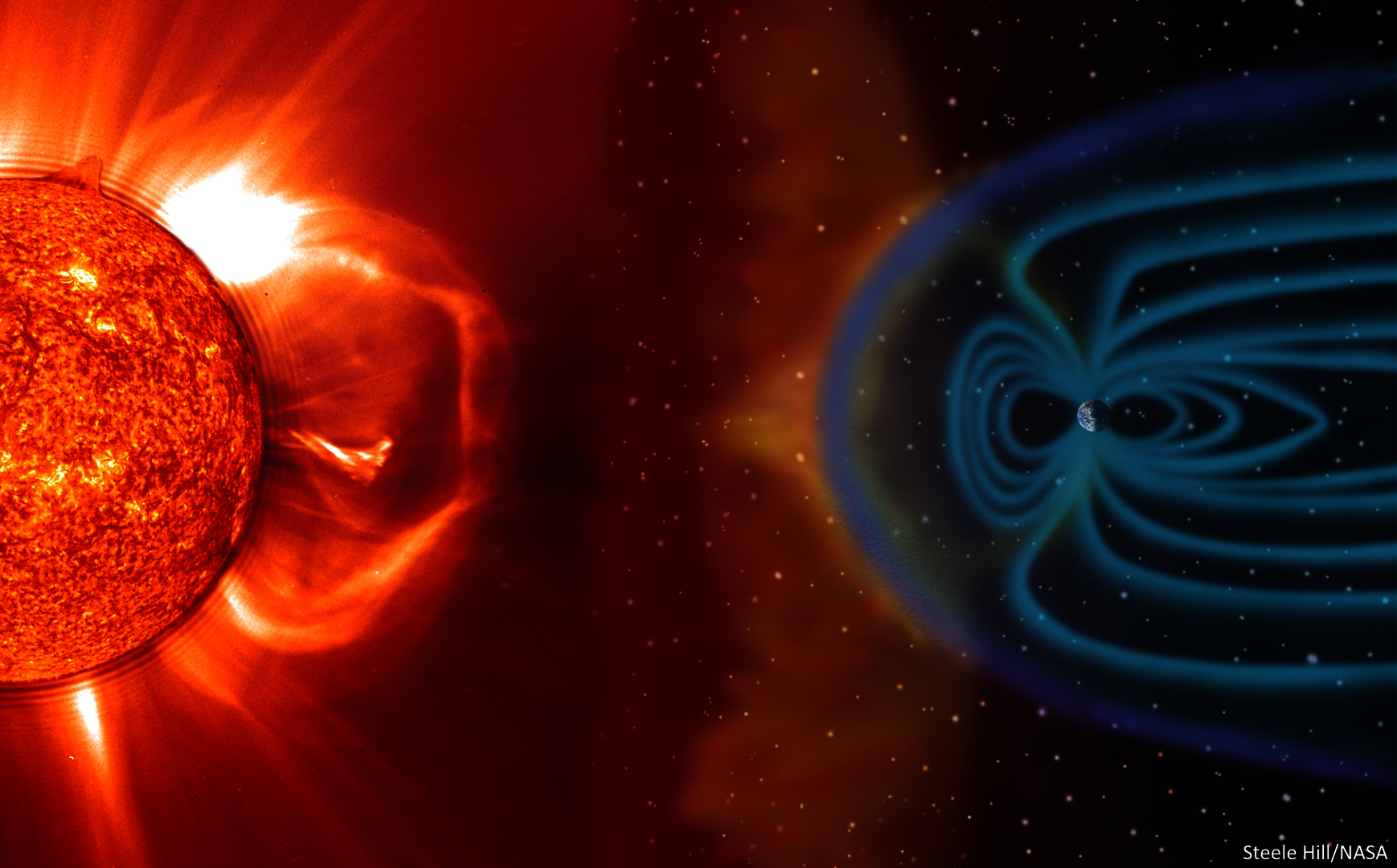
In space, radiation poses a significant risk. Sudden bursts of high-energy particles from the Sun, as well as long-term exposure to galactic cosmic rays, can have serious short- and long-term effects on astronaut health and can damage mission-critical electronic systems.
To better understand these risks and develop effective mitigation techniques, the group uses the GSI's particle accelerator to recreate space-like radiation environments here on Earth. The developed advanced irradiation methods allow to closely simulate solar particle events and galactic cosmic radiation, making it possible to conduct controlled experiments under realistic space radiation conditions. As galactic cosmic radiation is highly complex, composed of different particle types and a wide range of energies, it is essential to verify that the radiation fields reproduced on the ground accurately match those found in space. This is achieved through microdosimetric characterization, a well-established technique that is gaining renewed interest for its ability to comprehensively describe complex radiation environments. In addition, the group actively develops and tests radiation shielding solutions, measuring how different materials modify the radiation field and evaluating their effectiveness in reducing biological and technological risks. The group is actively working on the design and implementation of a Galactic Cosmic Ray (GCR) simulator at the FAIR accelerator facility. This simulator will be the first of its kind worldwide, capable of reproducing the GCR kinetic energy spectrum up to 10 GeV/u.
Main research topics:
Projects
- HEARTS https://hearts-project.eu/ (funded by EU)
- High-energy accelerators for radiation testing and shielding
- Heavy ion testing for space applications in Europe
- RADNEXT https://radnext.web.cern.ch/ (funded by EU)
- Radiation facility network for the exploration of effects for industry and researchHeavy ion testing for space applications in Europe
- Shielding Microdosimetric And doSimetric cHaracterization – SMASH (supported by the European Space Agency, ESA) in Europe
- Characterization of the GCR simulator field after shielding materials
- Comparison of performances of different radiation detectors
Software repositories:
GCR simulator Phase Space, https://github.com/chrischu0815/g4_ps_converter
Collaborations
CERN Radiation to Electronics (R2E) r2e.web.cern.ch
Deutsches Zentrum für Luft- und Raumfahrt (DLR), Radiation Biology group https://www.dlr.de/en/me/about-us/departments/radiation-biology
Italian Space Agency (ASI) https://www.asi.it/
Thales Alenia Space Italy, www.thalesaleniaspace.com/en
University of Rome Tor Vergata, HSERLab
University of Padua, Department of Information Engineering, https://www.dei.unipd.it/en/
University of Wollongong, Centre for Medical Radiation Physics https://www.uow.edu.au/research/centre-for-medical-radiation-physics/space-radiation-capabilities-of-uow-physics/

Group Members
Group leader:
Christoph Schuy
Postdoctoral fellows:
Tim Wagner
Enrico Pierobon
Ph.D. student:
Luca Lunati
Engineer:
Marie Schumacher
Intern:
Alexandra Neuhaus
Selected papers
- The HEARTS EU Project and Its Initial Results on Fragmented High-Energy Heavy-Ion Single-Event Effects Testing https://doi.org/10.1109/TNS.2025.3530502
- Physical basis of radiation protection in space travel https://journals.aps.org/rmp/abstract/10.1103/RevModPhys.83.1245
- Hybrid Active-Passive Space Radiation Simulation Concept for GSI and the Future FAIR Facility: https://www.frontiersin.org/journals/physics/articles/10.3389/fphy.2020.00337/full
- Ground-based passive generation of Solar Particle Event spectra: Planning and manufacturing of a 3D-printed modulator https://doi.org/10.1016/j.zemedi.2023.10.002
- Hybrid Active-Passive Galactic Cosmic Ray Simulator: in-silico design and optimization https://doi.org/10.1016/j.lssr.2026.02.003
- Hybrid Active-Passive Galactic Cosmic Ray Simulator: experimental implementation and microdosimetric characterization https://doi.org/10.1016/j.lssr.2026.02.004
Last update: 18.03.2026