


Exchange and future prospects: Helmholtz Center executive boards meet at GSI/FAIR


22.10.2026 |
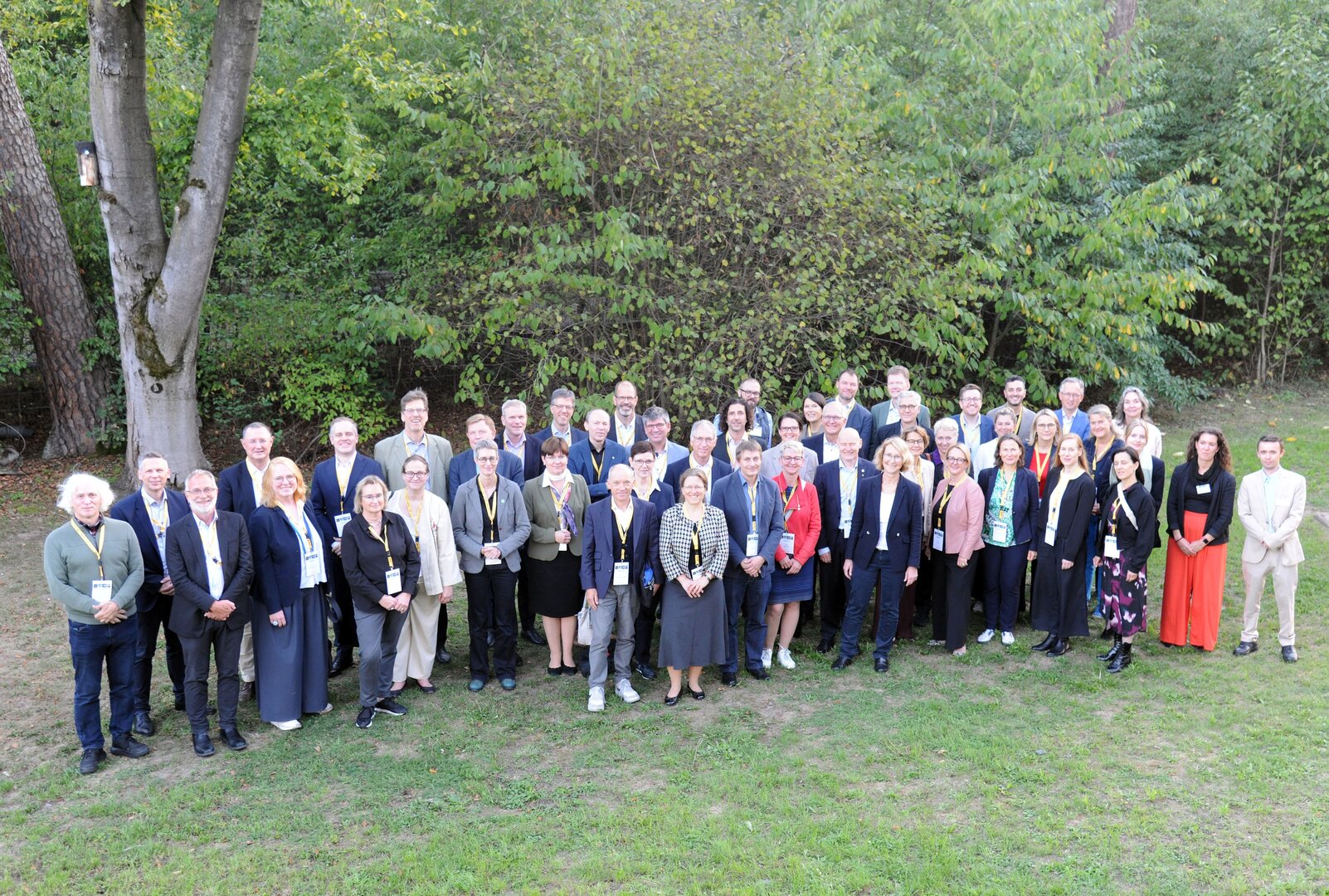
The Helmholtz Association held its most recent assembly of members at GSI in Darmstadt, one of its 18 research centers. The executive boards of the Helmholtz Centers met on the GSI/FAIR campus to discuss current developments, strategic priorities, and future collaboration within the research organization. The focus was on key topics in German cutting-edge research as well as the further development of joint research activities and programs.
The assembly of members is a central governing body of the association and provides participating centers with a regular opportunity to exchange information on ongoing projects, discuss developments in science policy, and develop shared perspectives.
The hosts from GSI/FAIR – Professor Thomas Nilsson, Scientific Managing Director, Dr. Katharina Stummeyer, Administrative Managing Director, and Jörg Blaurock, Technical Managing Director – were delighted to welcome their colleagues from the Helmholtz Association on the Darmstadt campus. “It was a special honor for us to host the assembly of members here in Darmstadt, and at the same time a wonderful opportunity to give our colleagues a glimpse into our research.”
Between sessions, the more than 50 guests from all over Germany also had the opportunity to visit the GSI research facilities and the construction site of the FAIR international accelerator center, which is currently being built here. Highlights of the tour of the construction site included the underground tunnel for the FAIR ring accelerator SIS100, the central intersection structure for beam guidance and distribution, as well as buildings for the CBM experimental site and the Super-FRS experimental facility.
In addition, the guests were able to tour the new FAIR Control Center (FCC)—the future control unit for the entire GSI and FAIR accelerator complex—which has just been completed and is equipped with state-of-the-art hardware and software. The tumor therapy facility and the Hades large-scale experiment, which was developed and built by more than 100 researchers from ten countries, were other stops on the tour. (BP)


