


Chemical bond of a superheavy element compound probed at GSI/FAIR

14.10.2026 |
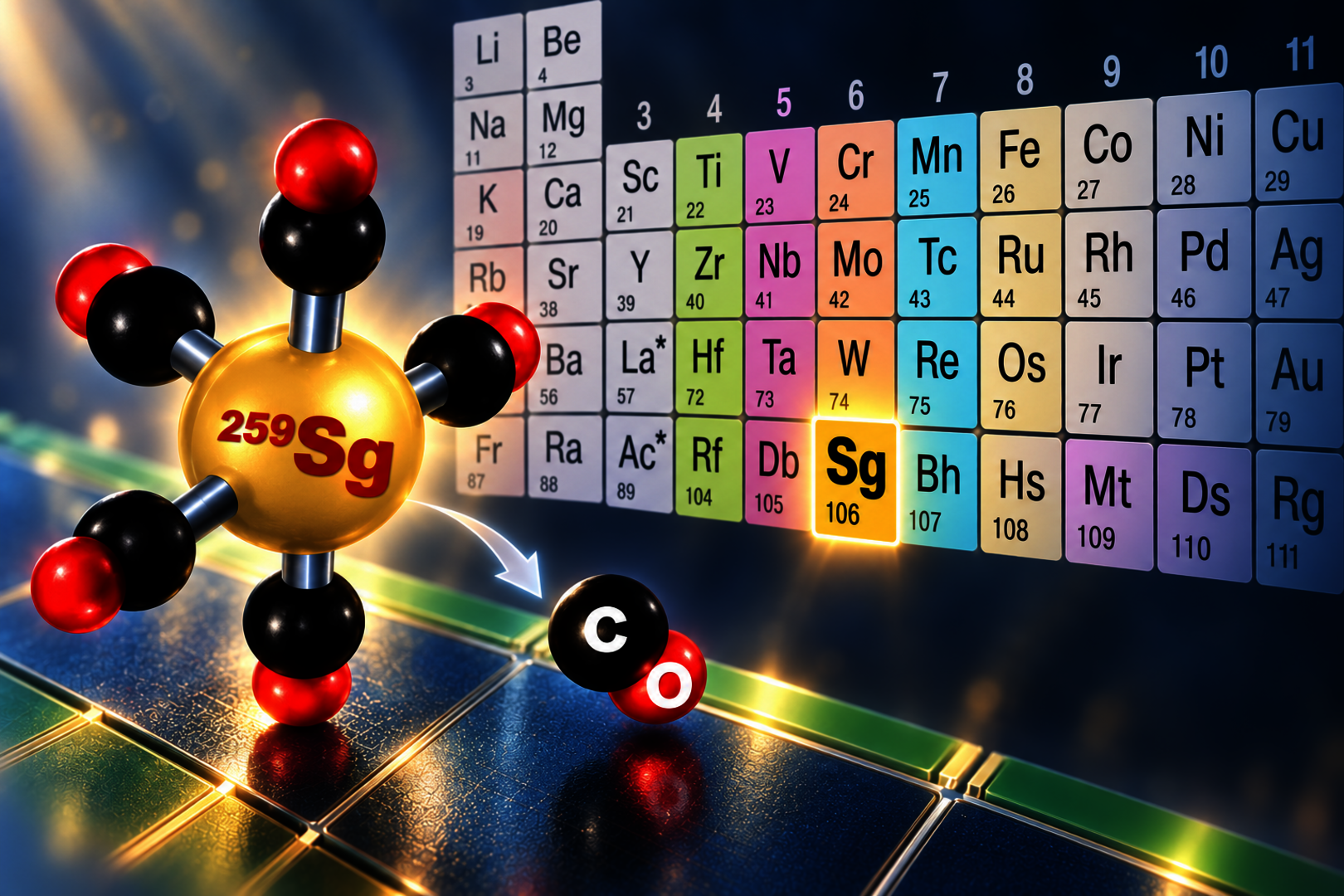
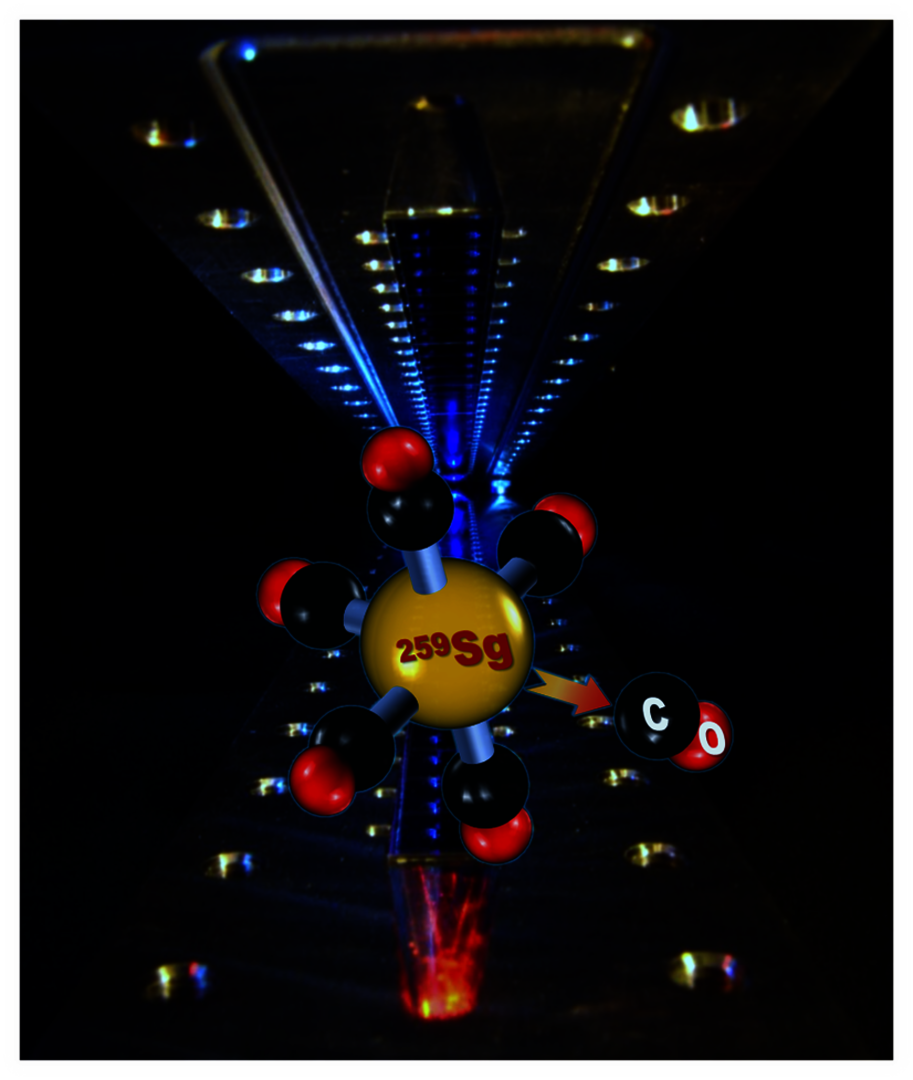
An international collaboration led by a research group from GSI/FAIR in Darmstadt, Germany, has achieved the first measurement of the chemical stability of a superheavy element compound. The focus was on the hexacarbonyl complex Sg(CO)6 of seaborgium (Sg, element 106). The result: The bond between the seaborgium atom and a carbonyl ligand is weaker than expected based on its position in the periodic table. Relativistic effects are the cause. The results are published in the journal Nature.
Superheavy elements (SHE) with atomic numbers from 104 to 118 are artificially produced in nuclear fusion reactions at particle accelerators — at rates of at most a few atoms per day. Due to their short lifetimes, in the range of seconds at most, chemical studies are very challenging. A prime interest in their study comes from tracing the influence of relativistic effects: Because of the high nuclear charge of SHE, electrons near the atomic nucleus are accelerated to velocities approaching the speed of light. According to Einstein’s famous theory of special relativity, objects moving near the limiting speed of light become heavier.
Bohr’s model of the atom tells us that this leads to the electrons residing closer to the nucleus and becoming more strongly bound. More distant electrons are not subject to relativistic mass increase and are even moved farther away because the stronger bound electrons shield the positive nuclear charge better. Both effects lead to changes in the electronic structure of superheavy atoms, and, thus, in the chemical properties of their compounds, compared to their lighter homologs. Comparative studies among like complexes of homolog elements thus allow probing fundamental underpinnings of the periodic table of the elements.
“For the first time, we succeeded in measuring the strength of the chemical bond in a compound of a superheavy element, namely that between the central seaborgium atom and a carbon monoxide ligand. We have then compared it to the strength of this bond in the hexacarbonyl of the lighter homolog, tungsten,” explains Dr. Alexander Yakushev of GSI/FAIR, spokesperson of the collaboration. “From chromium over molybdenum to tungsten, the bond strength in the hexacarbonyls increases, suggesting that it should be even stronger in seaborgium. But the measurements show that the high atomic number of seaborgium alters its electronic shell structure, overturning the trend and leading to a bond weakening.” Recent quantum-chemical calculations that take the influence of relativity into full account explain this effect. Simpler calculations neglecting the effects of relativity predict a continuation of increasing bond strength.
The Sg(CO)6 was synthesized for the first time about ten years ago at the RIKEN Nishina Center, Japan, in an experiment led by scientists from Johannes Gutenberg University Mainz (JGU) and GSI/FAIR as the first compound of the carbonyl class for a superheavy element. Its bonding properties made it immediately attractive for attempts to measure the strength of a chemical bond between the central seaborgium atom and a carbon monoxide ligand, but first attempts remained unsuccessful.
Key to experimental success are fast chemical syntheses with high yields, combined with elaborate methods to register the quick radioactive decay as needed for the identification of the single atoms. In the experiment at GSI/FAIR, the researchers produced the isotope seaborgium-259, for which two nuclear states with different but short lifetimes below half a second are known. For comparative purposes, the similarly short-lived tungsten isotopes 161 and 162 were produced.
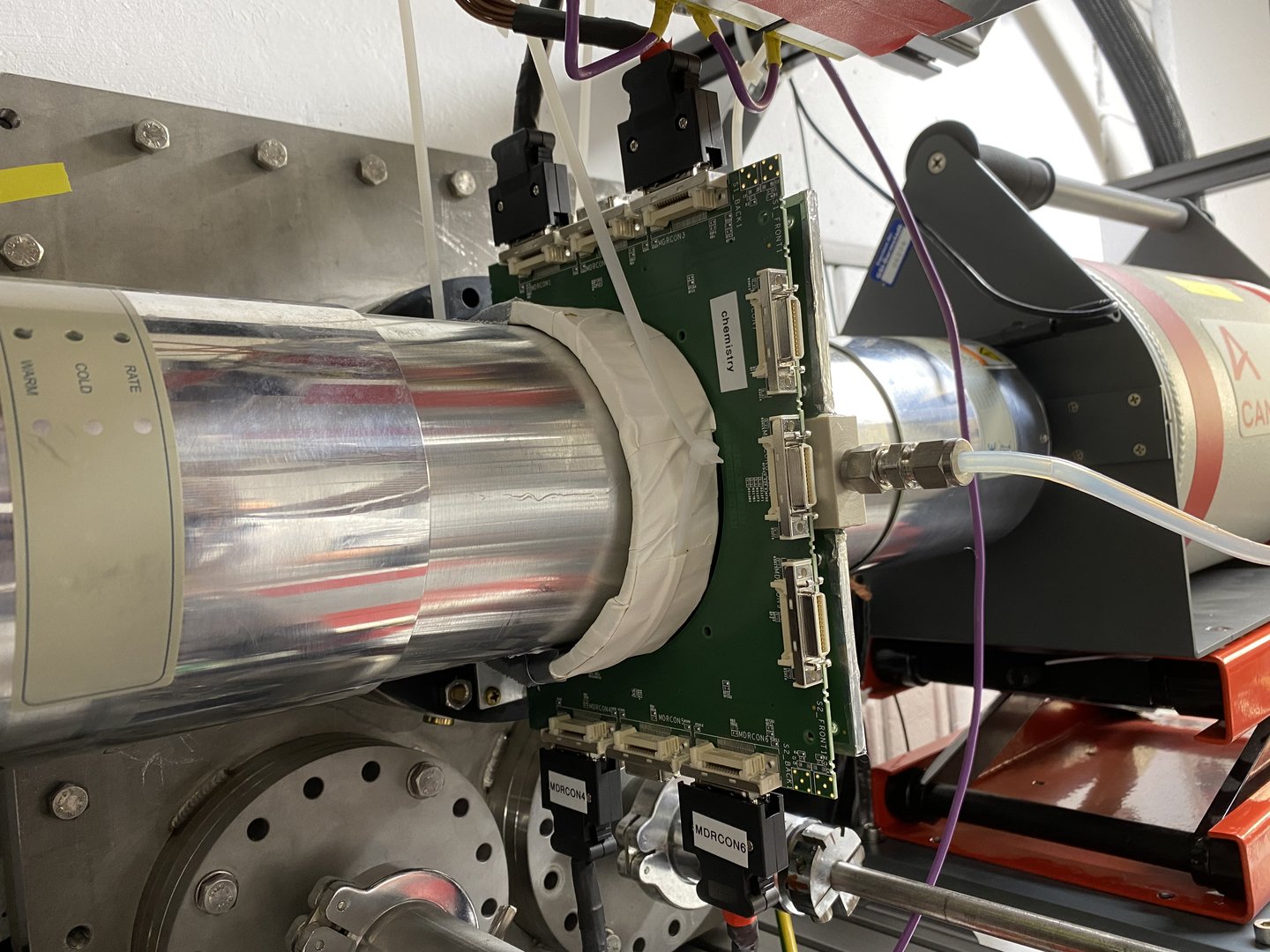
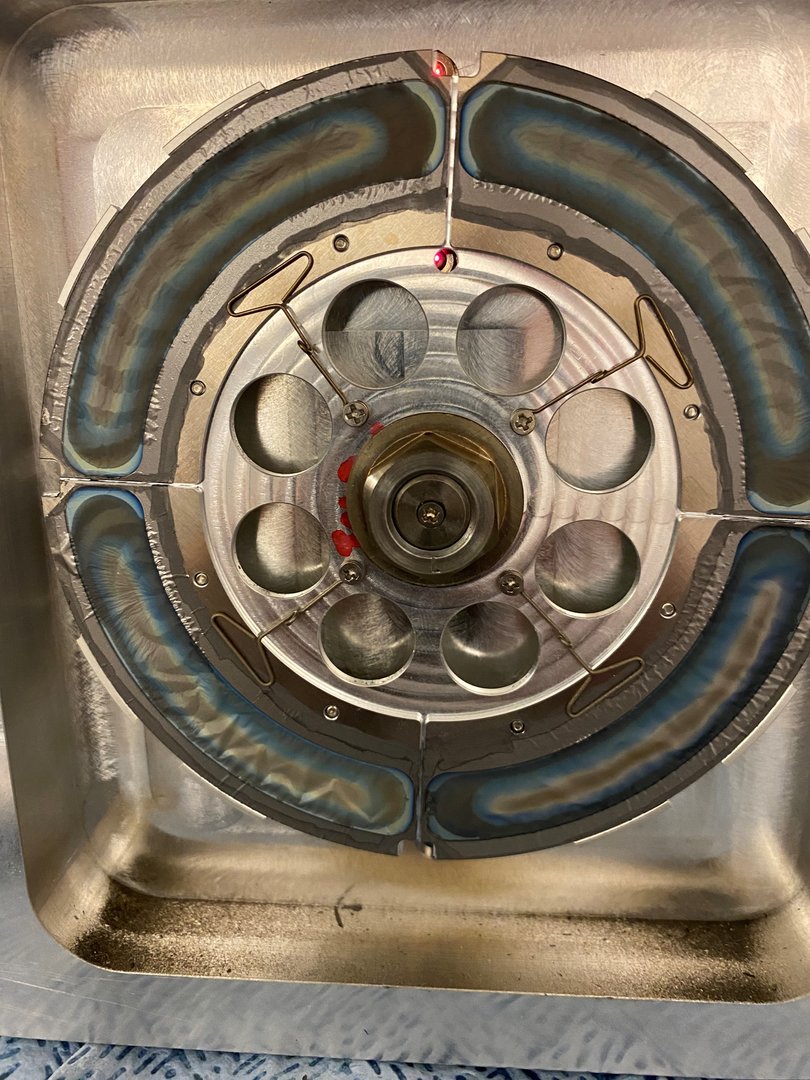
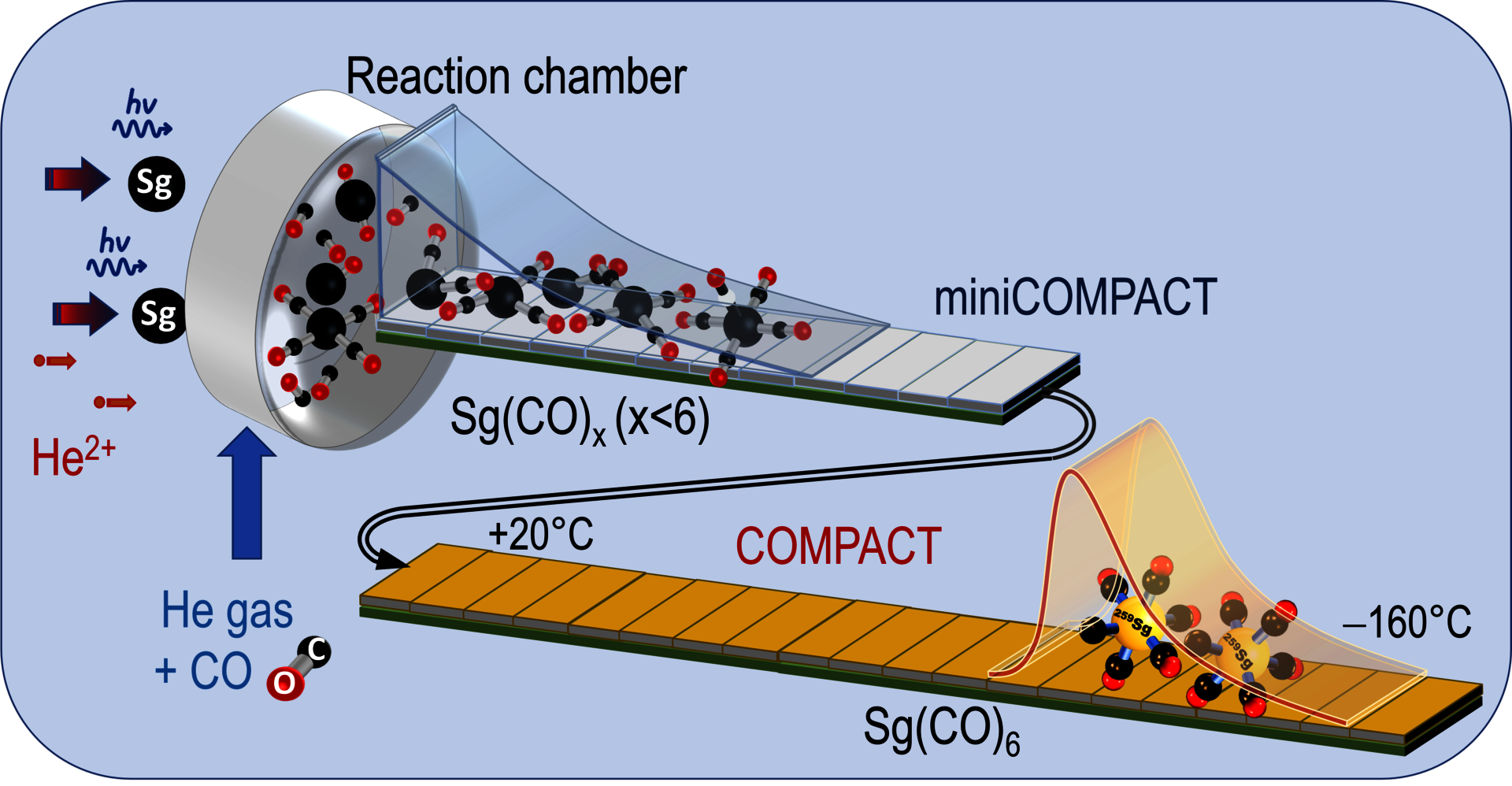
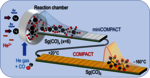
After production and isolation in the experiment setup TASCA (TransActinide Separator and Chemistry Apparatus), the atoms came to rest in a gas atmosphere containing carbon-monoxide. The gas led to compound formation and flushed all atoms into a narrow detector channel with two consecutive arrays to detect each atom by registering its nuclear decay. Products of the chemical reaction of seaborgium and tungsten with carbon monoxide remain chemically reactive and deposit on the first detector array— unless they form the volatile hexacarbonyl compound, which travels past this first channel, reaching a second detector array which is cooled to temperatures low enough to adsorb these complexes.
The efficiency for transformation into the hexacarbonyl complex depends critically on the bond strength between the sixth carbon monoxide ligand and the central atom. Measuring which fraction of all seaborgium atoms formed the hexacarbonyl complex thus allows deducing the strength of this chemical bond. In total, 75 seaborgium atoms were registered, thereof three in the hexacarbonyl-detector. In contrast, 17 percent of all tungsten atoms formed the analog compound. From the much lower yield of Sg(CO)6 compared to W(CO)6, a bond strength that is lower by 4 kJ/mol in Sg(CO)6 was deduced. Thus, the trend of increasing stability of hexacarbonyls within the chromium group from chromium over molybdenum to tungsten is inversed in seaborgium.
Professor Christoph E. Düllmann, head of the superheavy element chemistry departments at GSI/FAIR and at Helmholtz Institute Mainz and professor at Mainz University emphasizes: “This breakthrough experiment would not have been possible without interdisciplinary and international collaboration between research institutions from around the world. It complements the international scientific programs at GSI and FAIR, where the origin of the elements in the Universe and their properties are being investigated.”
After this first successful detailed study of the chemical bonding in molecules of superheavy elements, the researchers already prepare experiments with yet heavier elements beyond seaborgium. (CP/BP)
Further information
Scientific publication in the journal Nature


