


ANSWERS: A new doorway to explore superheavy nuclei


01.10.2026 |
A research team from GSI/FAIR in Darmstadt, Johannes Gutenberg University Mainz, and the Helmholtz Institute Mainz has studied four superheavy nuclei with a newly developed experimental technique. ANSWERS measures thus far inaccessible properties, which are important for understanding element synthesis in the Universe. The results are published in Physics Letters B.
ANSWERS (Adsorption-based Nuclear Spectroscopy Without Evaporation Residue Signal) transfers GSI/FAIR experimental techniques developed for the chemical investigation of superheavy elements to physics research. Superheavy nuclei often split into two lighter fragments due to the repulsive force between positively charged protons. However, the measurement of the fission fragments’ mass distribution (FFMD) and the sum of the kinetic energies of the two fragments represent an experimental challenge.
The FFMD plays an essential role in the theoretical description of the fission process and, in consequence, for the modeling of the rapid neutron capture process, which governs the astrophysical synthesis of all atomic nuclei beyond the heaviest stable elements, lead and bismuth. Unravelling this fission process is one of the key tasks to probe the current endpoint of the periodic table of the elements, to yet expand it, and to further our understanding of how the heaviest elements are being produced in the Universe.
Until now, no experimental technique was available to directly measure the FFMDs of superheavy nuclei produced at single-atom-at-a-time rates. “During the commissioning of our new chemistry detector, I realized that the gas-phase chemistry approach could be adapted to create a new experimental setup for nuclear physics. Thus, the new ANSWERS concept was born,” remembers first author Dr. Jadambaa Khuyagbaatar, the leader of the corresponding experimental program at GSI/FAIR.
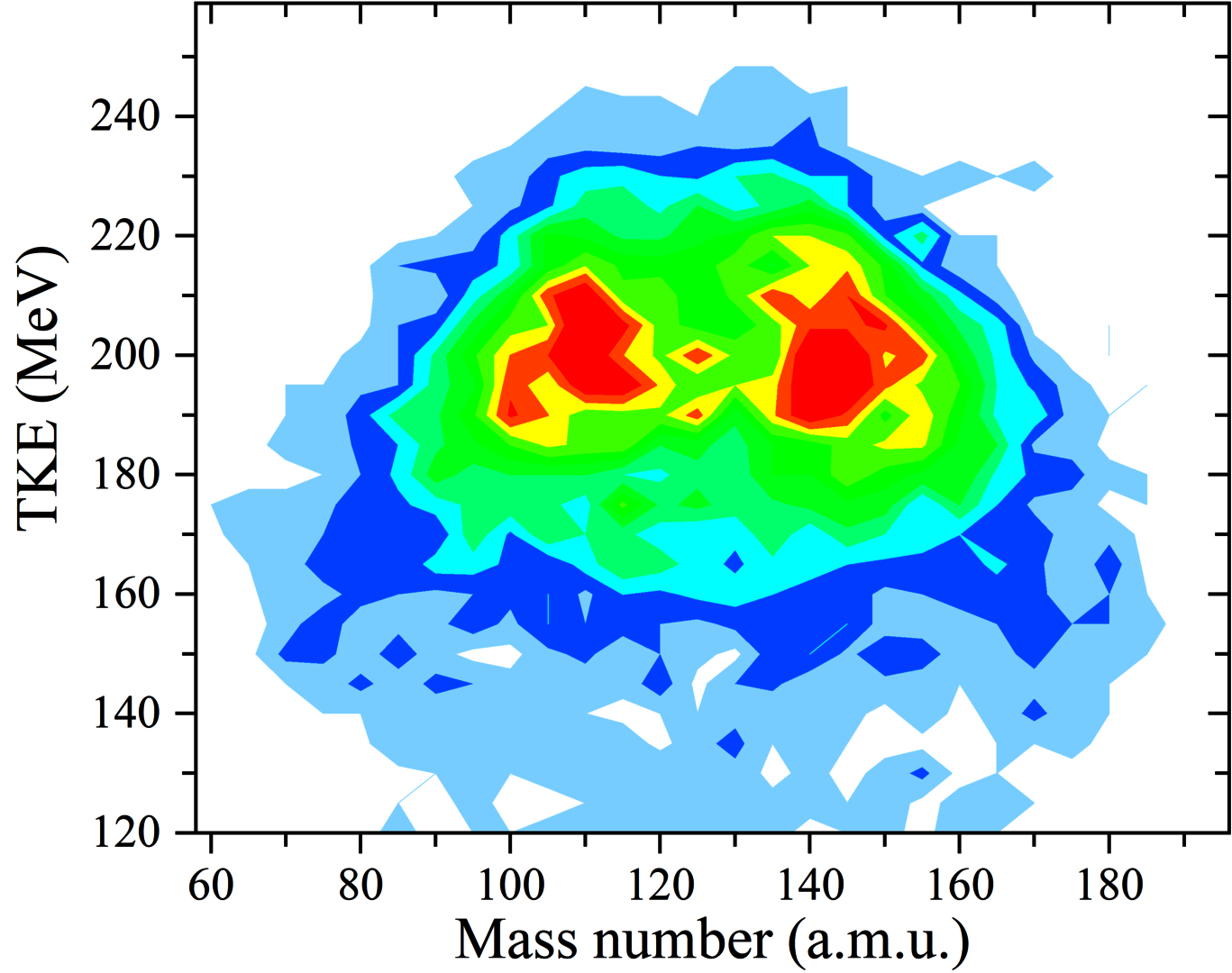
Even though superheavy nuclei with atomic numbers up to Z=118 (Og, oganesson) have been discovered and studied, experimental information on their FFMD currently exists only up to Z=104 (Rf, rutherfordium). In measurements with ANSWERS, the fission properties of californium-242, nobelium-252, lawrencium-264, and dubnium-268 have now been determined for the first time. While the first two nuclei exhibited asymmetric fission-fragment mass distributions, the heavier ones showed nearly symmetric-mass splits, associated with large total kinetic energies of the two fragments.
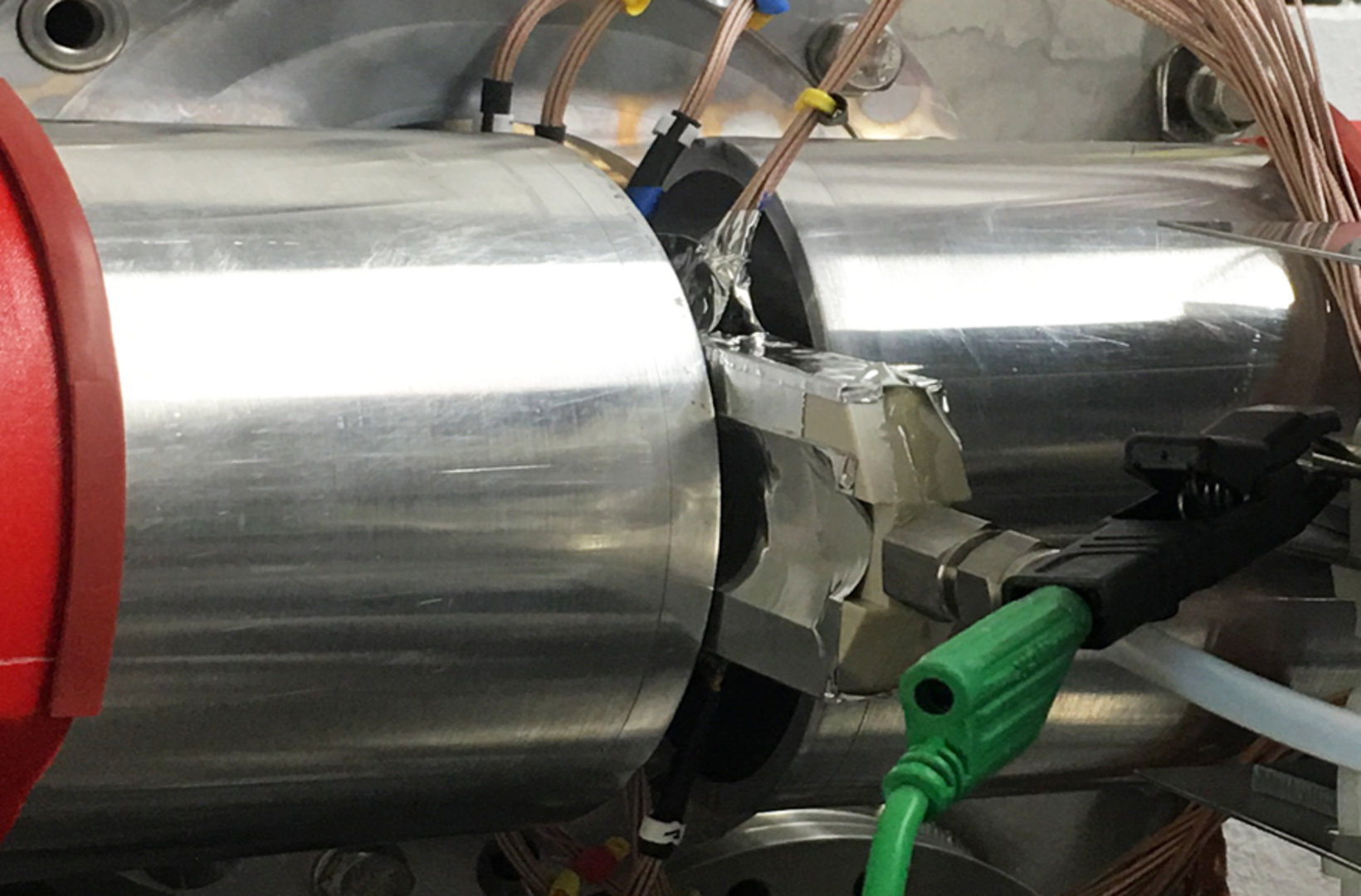
The basic principle of ANSWERS is to stop non-volatile superheavy atoms in a gas at atmospheric pressure and to flush them directly into a narrow channel formed by arrays of silicon detectors with their active sides facing each other. Once the atoms adsorb on the detector surfaces, their subsequent radioactive decays are measured under low-background conditions and with high geometric efficiency, leading to highly efficient multi-coincidence measurements. Specifically, fissioning nuclei emit their two fragments into individual detectors, which allows to register both fragments individually and to reconstruct their masses from the measured kinetic energies.
“ANSWERS is a prime example of fruitful interdisciplinary work, where the combined expertise from neighboring scientific fields allows advancing into new regions to answer fundamental questions beyond a single discipline” says Professor Christoph E. Düllmann, the head of the Superheavy Element Chemistry departments at GSI/FAIR and at the Helmholtz Institute Mainz, and professor at Johannes Gutenberg University Mainz.
How the FFMD evolves further towards Og is a main subject of theoretical debates. Fission may retain the well-known asymmetric mass-split observed in actinides including the well-known fissile uranium and plutonium nuclei with one fragment having a mass number around 140; other scenarios suggest the FFMD to evolve toward splits into two fragments of about equal mass (symmetric fission).
Further intriguing scenarios require experimental verification, e.g. the potential formation of a doubly magic fragment, either tin-132 or lead-208, both of which contain filled proton and neutron shells. In particular, fission leading to a lead-208 fragment has only been predicted theoretically but never been registered experimentally, but may be expected to occur in the heaviest nuclei (e.g., in oganesson-294, the heaviest known nucleus). “In the future, ANSWERS can make important contributions to answering these questions and help us understand the element synthesis in the Universe,” says Khuyagbaatar. (CP)


