


Antiproton storage and transport records achieved


28.09.2026 |
This news is based on a press release by Heinrich Heine University Düsseldorf
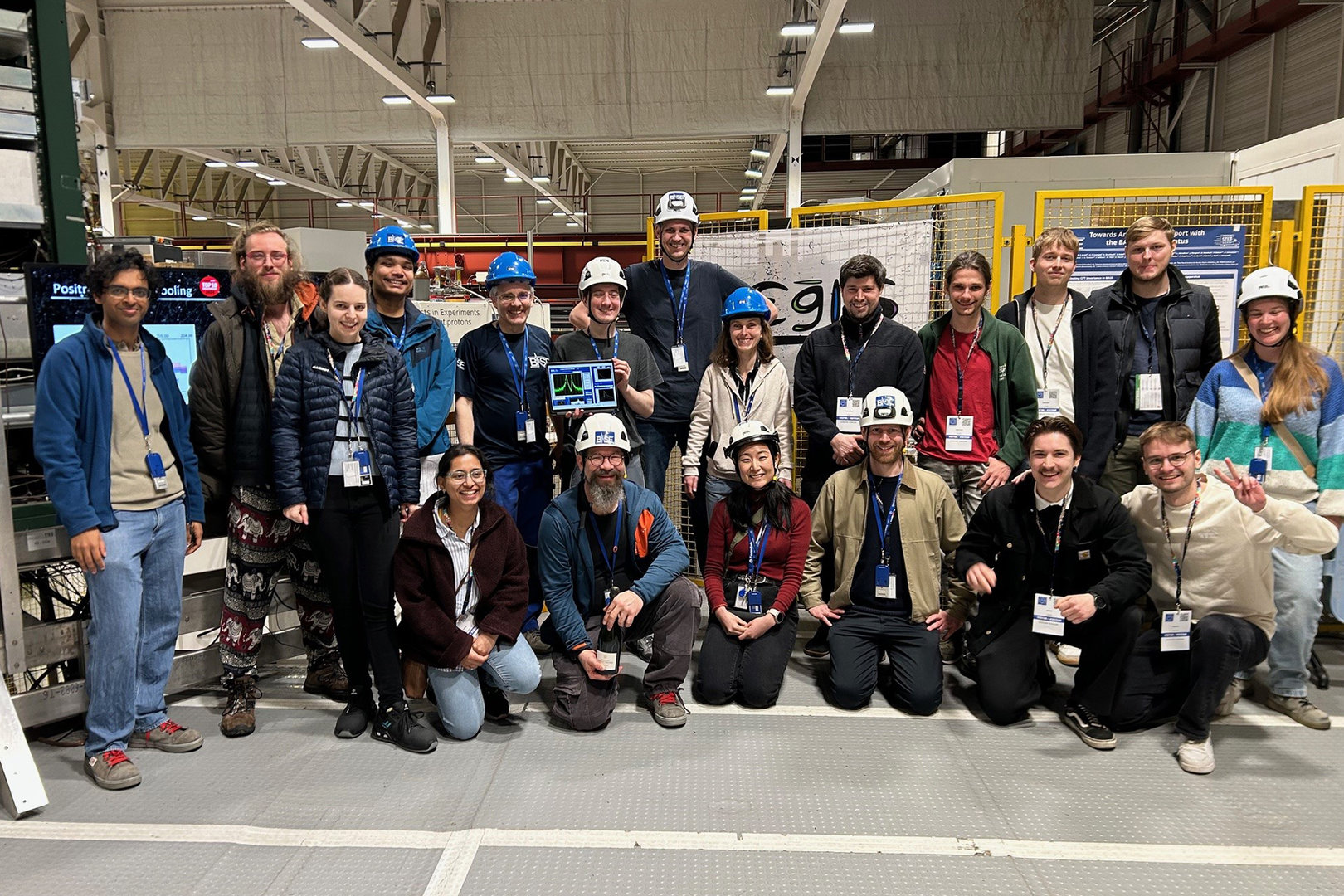
In March 2026, scientists succeeded in transporting antiprotons by road for the first time in a purpose-built trap loaded on a truck. The BASE collaboration, which realised this experiment at the European Organisation for Nuclear Research (CERN) in Geneva and of which GSI/FAIR is a member, now presents its findings and experiences from this pioneering experiment in the scientific journal Nature. Antiprotons could be stored for the first time ever for more than a month in a mobile transport vessel.
Comparing protons – the positively charged components of an atomic nucleus – with antiprotons – their antimatter counterparts – is one of the most promising methods for seeking differences between matter and antimatter. Any identified difference in their mass or magnetic moment could point to the potential origin of the matter-antimatter asymmetry that can be observed in the cosmos.
So-called ultra-high vacuum Penning traps enable such high-precision measurements of the protons and antiprotons confined in them. The BASE (Baryon Antibaryon Symmetry Experiment) research collaboration designed and now operates a trap of this kind – known as BASE-STEP – at CERN, or more precisely the “Antimatter Factory” (AMF) there. The AMF is the only facility worldwide where low-energy antiprotons can be produced, stored and studied.
Professor Stefan Ulmer, holder of the Chair of Quantum Technologies and Fundamental Symmetries at HHU, is the founder and spokesperson of BASE, and co-author of the new study in Nature: “In recent years, we have already achieved precision measurements of the intrinsic magnetic moment of both types of particles with an accuracy of 0.3 ppb for protons and 1.6 ppb for antiprotons.” The abbreviation ppb stands for parts per billion and equates to 1x10⁻⁹. To date, however, comparisons of the obtained data on protons and antiprotons have not yet identified any difference within the achievable measurement accuracy.
Dr Christian Smorra, BASE-STEP principal investigator and corresponding author of the study: “We cannot improve the level of measurement accuracy any further at the AMF as facility operation causes magnetic-field fluctuations, which affect our measuring equipment. We can only find better conditions outside CERN. And so the idea of the mobile open BASE-STEP trap was born: We will transport the antiprotons to another location with a high-precision laboratory in order to achieve an at least 100-fold improvement in precision.”
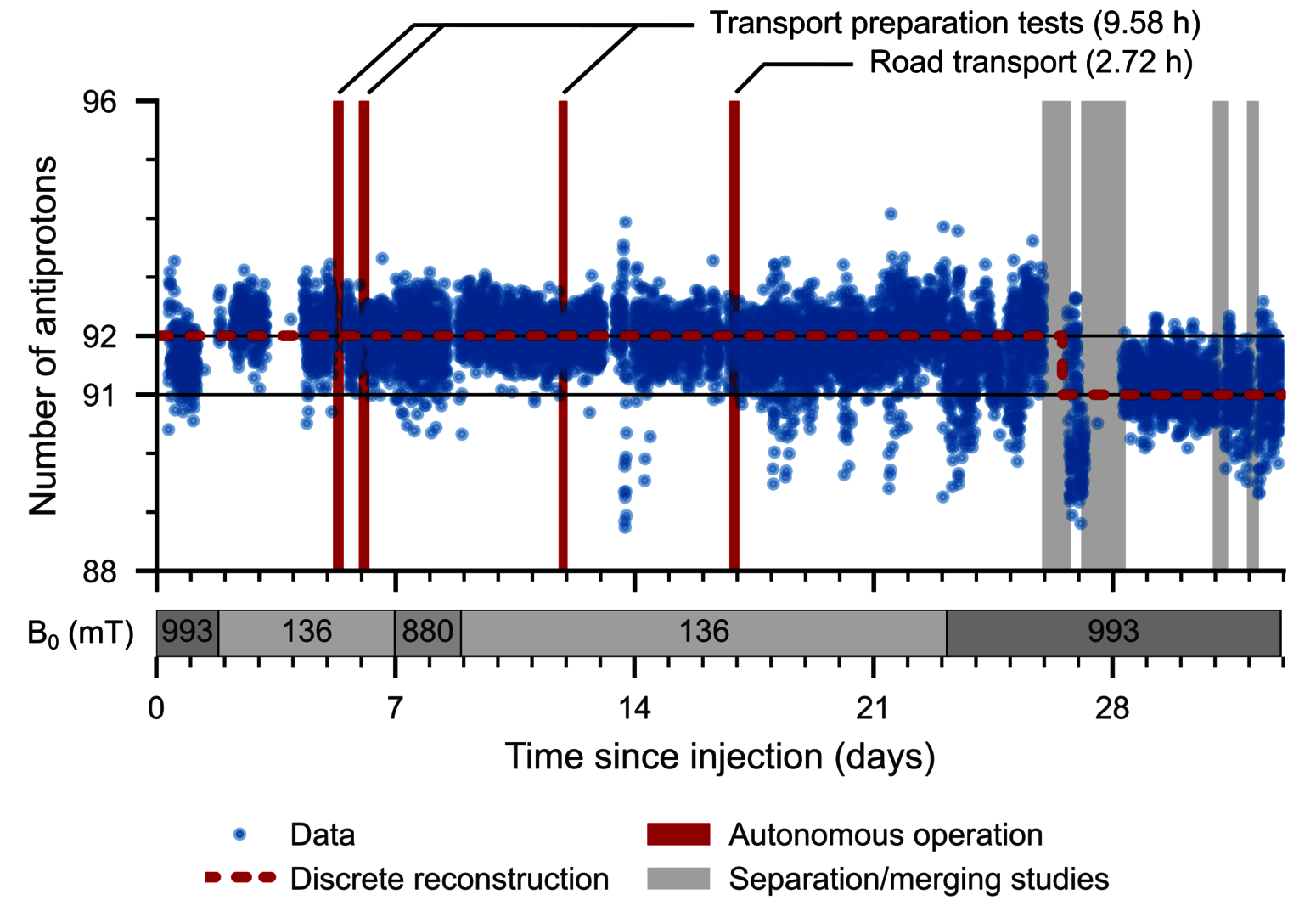
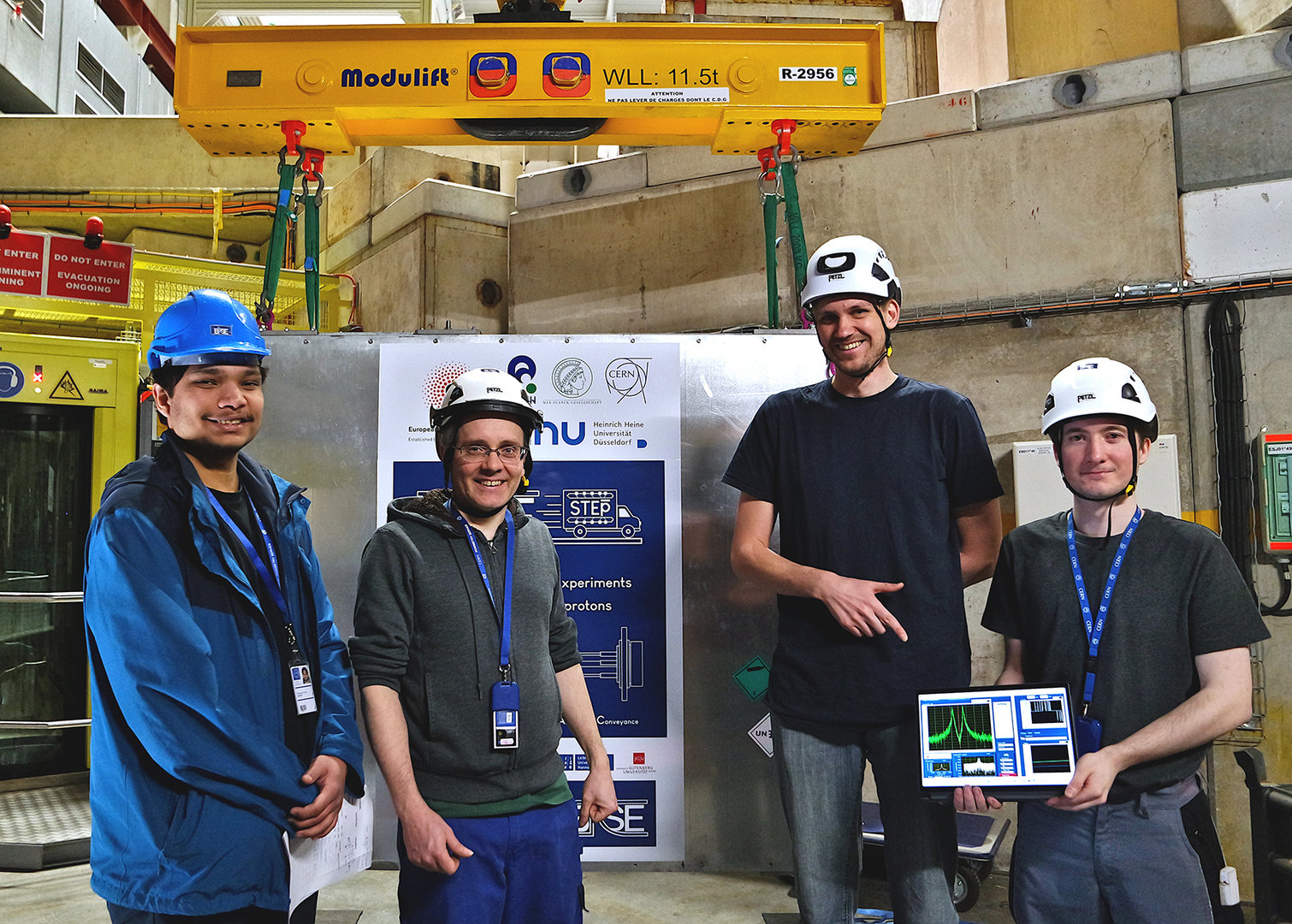
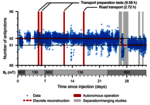
Following the success of the proton transport in October 2024, the BASE team then succeeded in using the same trap to transport antiprotons in March 2026. A total of 92 of these particles were extracted from the AMF and stored in BASE-STEP. The trap was then loaded onto a truck and driven around the CERN site for half an hour, covering a distance of approx. eight kilometres. The team then also succeeded in unloading the trap again without losing even one of the stored antiprotons.
Marcel Leonhardt, doctoral researcher in physics at HHU and lead author of the study: “We then continued to observe the antiprotons. We were able to store and manipulate them in a controlled manner for more than a month in total.” He also highlights a special achievement: “It is particularly important to realise an extremely good vacuum in a mobile trap for long-term storage to ensure that the antiprotons are not lost through collisions with other particles. In a world first for an open trap system into which antiprotons can be injected and subsequently extracted again, we achieved a vacuum of better than 2.2x10⁻¹⁸ mbar throughout the storage period – a substantially better figure than our own design target of 1x10-16 mbar.”
One destination for the stored antiprotons is the high-precision laboratory currently being established at HHU by Ulmer’s team to enable comparison measurements of protons and antiprotons. “We completed a successful dress rehearsal with the transport in March and were able to demonstrate that our idea works. Our next target is to make the trap sufficiently autonomous to allow a ten-hour transport from Geneva to Düsseldorf,” states Dr Smorra.
Professor Ulmer on the background to the research: “Our goal is to answer one of the most fundamental questions in physics: Why does a universe filled with matter exist? If an asymmetry between matter and antimatter were to exist, then a minute amount more matter than antimatter may have been produced during the Big Bang, meaning that a net excess of matter remained while the antimatter annihilated in full.”
The GSI/FAIR research department for Atomic, Quantum and Fundamental Physics is a long-standing member of the BASE collaboration. “Furthermore, GSI/FAIR has supported the project by delivering high-precision components manufactured in its mechanical workshop,” reports Dr. Wolfgang Quint, Head of Decelerator Experiments at GSI/FAIR. “In the future, the transport technology could be used to provide highly charged heavy ions, as they are available at GSI/FAIR’s HITRAP facility, to other research institutes.” (HHU/CP)
The BASE collaboration and BASE-STEP
Established in 2012 and based at the Antimatter Factory (AMF) at CERN, research institutes in Germany, Japan, the United Kingdom and Switzerland are involved in the BASE collaboration, including:
- National Metrology Institute of Germany (PTB), Braunschweig
- GSI Helmholtz Centre for Heavy Ion Research, Darmstadt
- Heinrich Heine University Düsseldorf
- European Organisation for Nuclear Research (CERN), Geneva
- Leibniz University Hannover
- Max Planck Institute for Nuclear Physics, Heidelberg
- Imperial College London
- Johannes Gutenberg University Mainz
- RIKEN, Japan
- University of Tokyo
- Swiss Federal Institute of Technology in Zurich
The founder and spokesperson of the collaboration is Professor Stefan Ulmer, holder of the Chair of Quantum Technologies and Fundamental Symmetries at HHU. He is also Chief Scientist at RIKEN in Japan.
Within the framework of the BASE collaboration, the STEP project – in which the transportable antiproton trap was developed – is funded by the ERC. This project is headed by Dr Christian Smorra.
Further information
- Scientific publication in the journal Nature
- Press release of Heinrich Heine University
- BASE website
- Nature publication on antimatter transport from May 2025


