


JLU and GSI/FAIR strengthen cooperation: Joint appointment of Maxim Mai to the Heisenberg Professorship in Theoretical Hadron Physics
02.09.2026 |
Joint press release of Justus-Liebig-Universität Gießen and GSI/FAIR
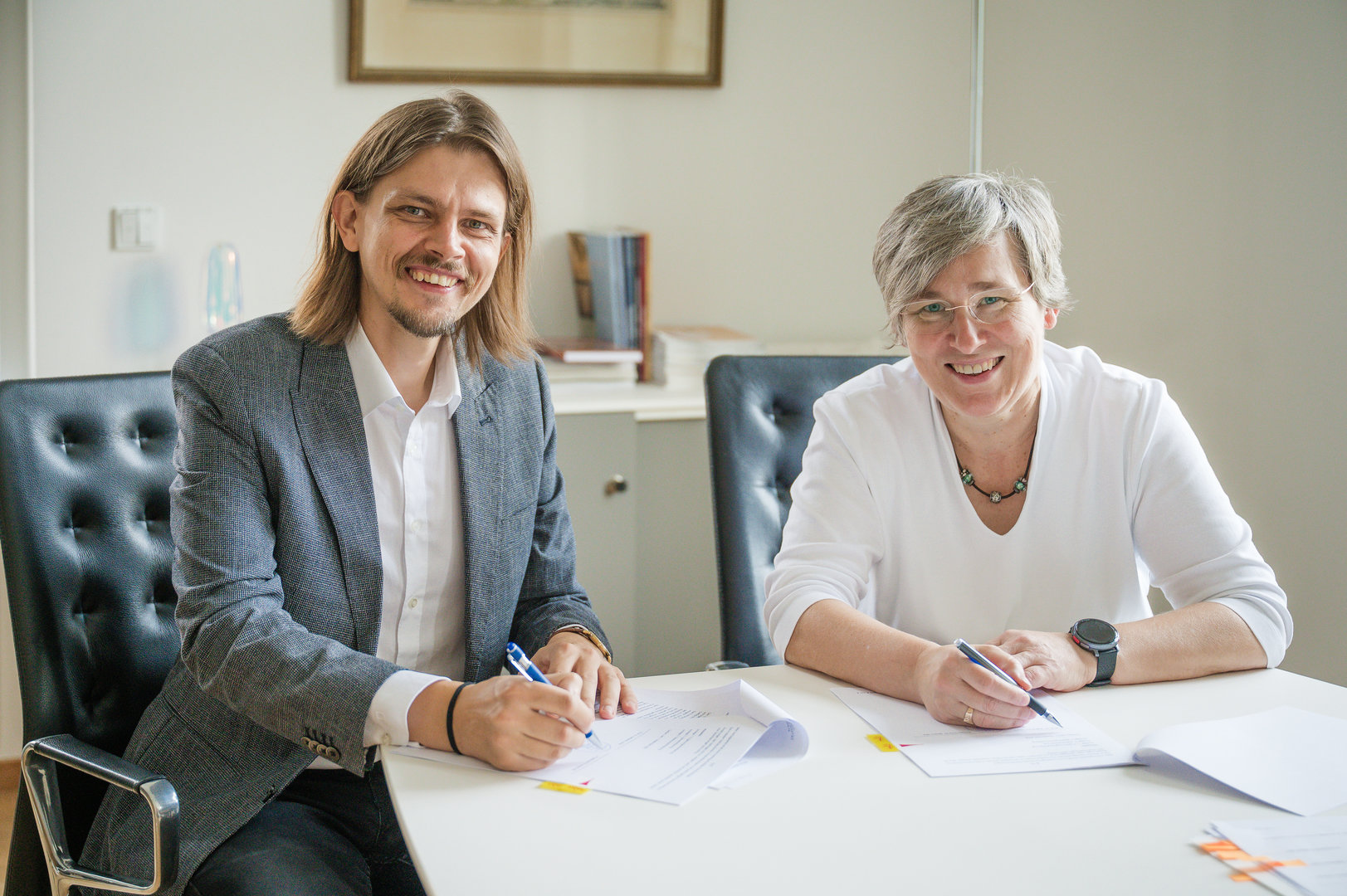
Physicist Professor Maxim Mai has been appointed to the professorial chair of Theoretical Hadron Physics at Justus Liebig University Gießen (JLU), starting on September 1, 2026. This is a joint appointment with the GSI Helmholtzzentrum für Schwerionenforschung in Darmstadt, to which JLU has been closely linked through a cooperative partnership for more than 15 years. The professorship is being established as part of the German Research Foundation’s (DFG) Heisenberg Program.
“With the joint appointment of Professor Mai, we are strengthening our collaboration with GSI, one of the world’s leading large-scale physics research facilities,” said JLU President Professor Katharina Lorenz. “This includes the international accelerator center FAIR, currently under construction at GSI, which will unlock unprecedented research potential in the coming decades.”
The Scientific Director of GSI and FAIR, Professor Thomas Nilsson, emphasizes: “This appointment is not only a recognition of Professor Mai’s scientific excellence. It also underscores how essential the connection between theory and experiment is for advancing excellent fundamental research. We are pleased that this professorship will further strengthen the ties between GSI/FAIR and JLU, thereby providing new impetus for research.”
Professor Mai’s research focuses primarily on how states of matter arise and behave at the smallest scale. In his work, he employs complex mathematical methods from particle physics, such as quantum chromodynamics, and modern approaches to machine learning. His research focuses on excited states of matter as well as short-lived excitations of hadrons—particles such as protons and pions. Pions are exchanged between protons and neutrons when they come close to one another within the atomic nucleus. The exchange of pions generates a force that holds the atomic nucleus together.
At JLU, Professor Mai will contribute, among other things, to the “Smallest Particles” research area within the Department of Mathematics and Computer Science, Physics, and Geography. A key focus of his work will be theoretical research in hadron physics, with an emphasis on the topics being addressed in current and future experiments at GSI/FAIR. In addition, Professor Mai will be actively involved in the graduate programs at JLU and GSI/FAIR, particularly at the Gießen Graduate Center for Natural Sciences and Psychology (GGN) and the Helmholtz Graduate School for Hadron and Ion Research (HGS-HIRe for FAIR).
Following the Heisenberg grant, Professor Mai will take a leave of absence from JLU under the so-called Jülich Model to take on leadership and research responsibilities at GSI/FAIR. Even then, he will continue to teach at JLU.
Until he was appointed to JLU, Mai worked as a Heisenberg Fellow at the Albert Einstein Center for Fundamental Physics at the University of Bern (Switzerland). He studied theoretical physics and differential geometry at the University of Bonn, where he also earned his doctorate, completed his habilitation in 2024, and subsequently served as a private lecturer. He was active for many years at George Washington University in the United States, where he continues to serve as a research professor. (JLU/BP)
About Justus Liebig University Gießen
Founded in 1607, Justus Liebig University Gießen (JLU) attracts approximately 25,000 students to this young city on the Lahn with its diverse range of academic programs. The university offers its researchers ideal conditions for interdisciplinary collaboration—particularly with its range of disciplines in the life sciences, which is unique in Germany: human and veterinary medicine, agricultural, environmental, and nutritional sciences, and food chemistry. This makes JLU a leading center for “One Health” research, which addresses global challenges at the intersection of health, the environment, and nutrition. No fewer than three Clusters of Excellence in perception, cardiopulmonary, and battery research make JLU one of the most successful universities in the federal and state governments’ Excellence Strategy. In addition, the university actively assumes responsibility for society: a good third of its students are preparing for a state examination—JLU is thus training the teachers, judges, physicians, and veterinarians of the future.
About GSI/FAIR
The GSI Helmholtzzentrum für Schwerionenforschung in Darmstadt has been operating world-leading particle accelerator facilities for decades. Currently, the international accelerator center FAIR is being built there, one of the largest research projects in the world. With FAIR, matter will be produced in the laboratory and studied in ways that otherwise only occur in the universe. Researchers from around the world use the facilities for experiments to gain new insights into the structure of matter and the evolution of the universe. In addition, they are developing novel applications in medicine and technology.


