


ALICE-Masterclass 2026 at GSI/FAIR – High-school students analyze experiment data
23.03.2026 |
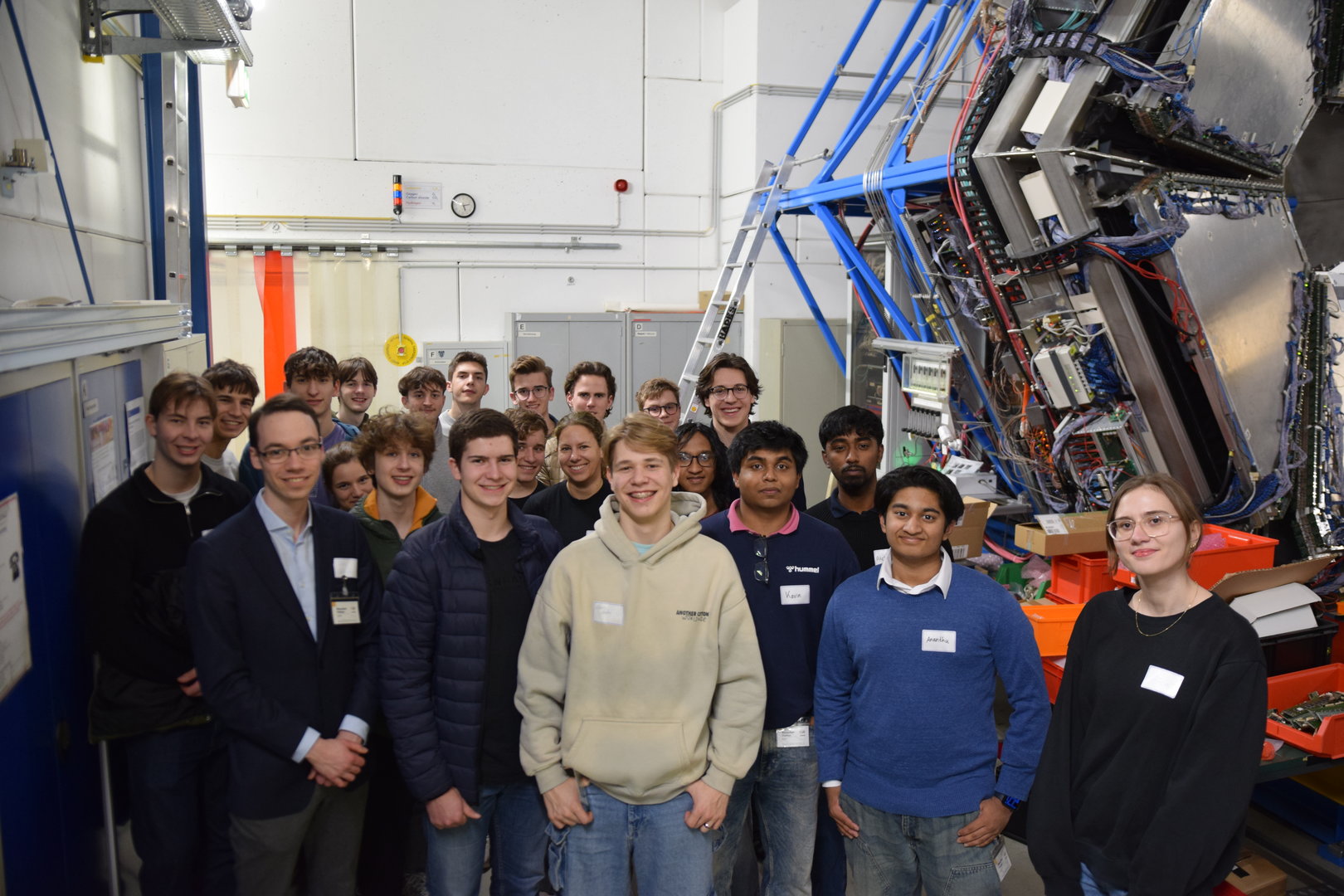
During the ALICE Masterclass on the GSI/FAIR campus, again this year 19 high-school students had the opportunity to analyze data from the ALICE experiment at the CERN research center. GSI/FAIR significantly contributes to the construction, operation and data analysis of ALICE. Scientists of GSI/FAIR’s ALICE research department organized the event.
In the framework of the ALICE Masterclass, the students gained insight into the scientific work and data analysis. Under guidance of the expert scientists on site, they analyzed the ALICE experiment data taken in proton-proton collisions as well as collisions of lead nuclei. On a tour of the GSI/FAIR campus, they learned about accelerator and detector components and took a look at the FAIR construction site from the viewpoint. To conclude the day of research, they discussed their results with other participants in a joint video conference with the universities in Frankfurt and Münster.
ALICE is one of the four large-scale experiments of the LHC collider at the CERN research center in Geneva and investigates in particular heavy-ion collisions of lead atomic nuclei. When lead nuclei collide with unimaginable impact in the LHC, conditions are created similar to the first moments of the universe. During the collisions, a so-called quark-gluon plasma is formed for a very short time — a state of matter that existed in the universe shortly after the Big Bang. This plasma transforms back into normal matter within fractions of a second. The particles produced in the process provide information about the properties of the quark-gluon plasma. Thus, the measurements can peer into the birth of the cosmos and reveal information about the basic building blocks of matter and their interactions.
The relationship between GSI/FAIR and ALICE is very close: The two large ALICE detector systems Time Projection Chamber (TPC) and Transition Radiation Detector (TRD) were designed and built with significant contributions of GSI/FAIR’s ALICE department and Detector Laboratory. Today scientists from both departments focus on the TPC, which is the centerpiece for track reconstruction in the central ALICE barrel setup and is also indispensable for particle identification. Scientist from the IT department of GSI/FAIR contribute significantly to the new data acquisition and analysis software O2, and the computing center is an integral part of the network for data analysis of the ALICE experiment.
The Masterclasses are organized by the IPPOG (International Particle Physics Outreach Group), of which GSI is an associate member. Each year, more than 13,000 students from over 60 countries take part in the events of about 225 universities or research centers for a day to unlock the mysteries of particle physics. All events in Germany are held in collaboration with the Netzwerk Teilchenwelt, in which GSI/FAIR takes part. The goal of the nationwide network for communicating particle physics to young people and teachers is to make particle physics accessible to a broader public. (CP)


