


High tech for FAIR
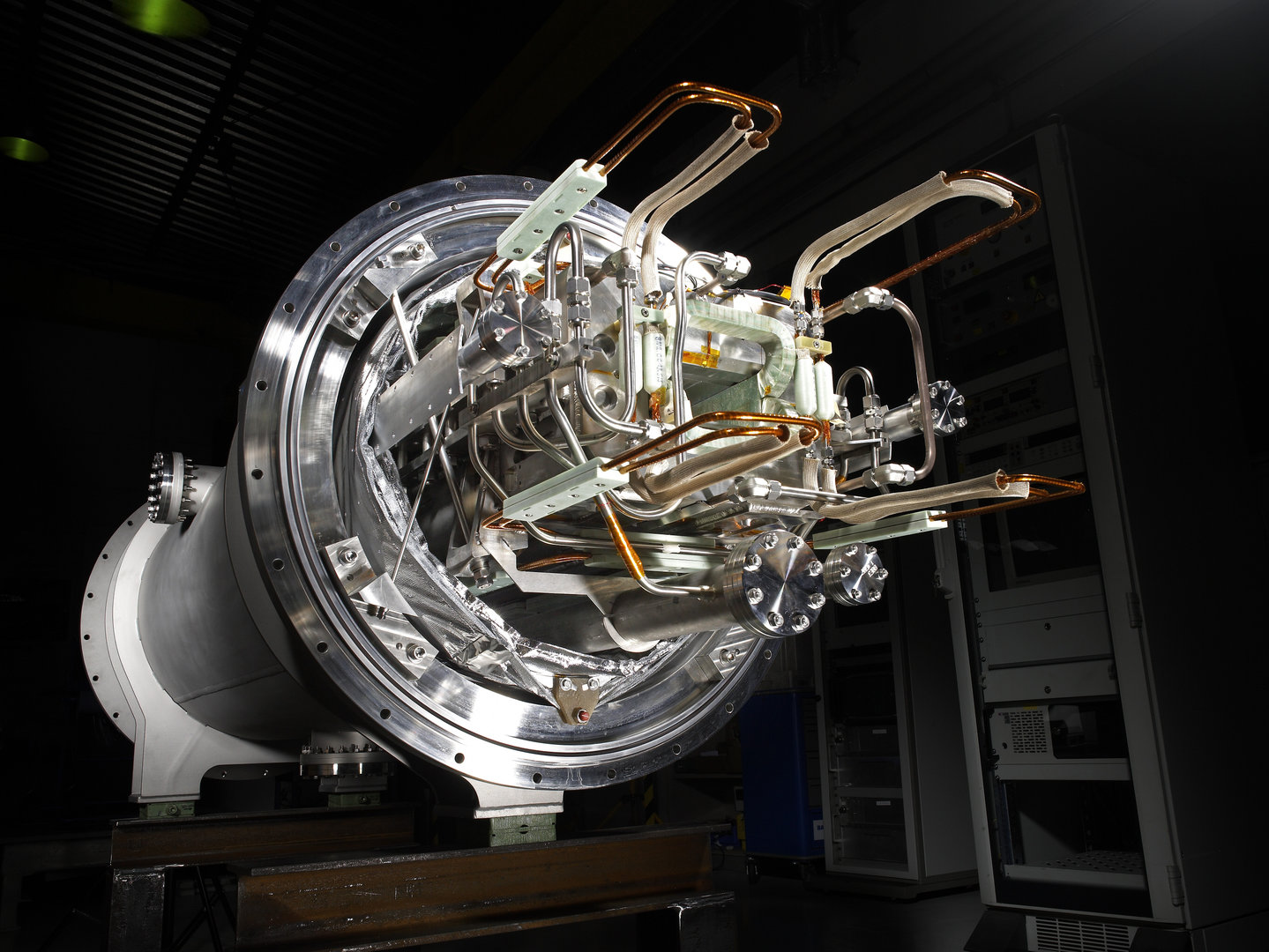

Cutting-edge technologies and extremely innovative measuring methods and techniques are being developed for the unique FAIR particle accelerator facility. In order to create the acceleration and experimental facilities, high-level scientists, engineers, and other experts are working in international partnership to advance new technological developments in many areas such as information and superconductor technology.
Superconducting magnets and an ultra-high vacuum
The SIS100 ring accelerator and many experiments need superconducting magnets in order to guide the extremely fast-moving particles. The magnetic fields must be very strong and capable of being rapidly changed while maintaining extremely high field precision. In addition, an ultra-high vacuum (1015 times less than atmospheric pressure) must prevail in large parts of the facility so that the highest possible particle intensities can be generated. Special technologies such as specially coated cryo-collimators are being developed for this purpose.
Cryogenics
An ultra-high vacuum and superconductivity can be created only with the help of cryogenics. The components are cooled off to temperatures as low as -269°C by means of liquid helium.
Control systems
With the help of the new joint control systemfor the existing GSI and the future FAIR accelerators ten thousands of components will be controlled. A procession of commands within nanoseconds enables the efficient operation of the accelerator facility and the optimal performance of the experiments. To maximize the experimental time several research programs can be conducted in parallel. The efficient parallel operation even makes it possible to use different types of ions.
Big data

To efficiently analyze and store the vast amounts of data generated in the experiments, innovative computer systems are operated in a dedicated data center. Scientists employ these systems to derive scientific insights from the data streams (in the future reaching up to 1 TB per second at FAIR), increasingly using AI-based methods. Particular attention is paid to the sustainable design of the computer systems, from the data center down to the software.
The Green IT Cube data center offers outstanding energy and cost efficiency, which is based on a cooling concept specifically designed to meet FAIR’s requirements. In recent years, the data center has been continuously refined in close collaboration with industry partners in the framework of the Digital Open Lab, leading to the development of innovative direct liquid cooling solutions capable of meeting the cooling demands of today’s high-performance systems in an energy-efficient way.
Materials development
For several areas of the FAIR accelerator facility new materials have to be developed. For example, materials for accelerator components, detectors and read-out electronics are needed which are suitable for higher particle intensities. Partly these materials are developed at GSI and FAIR.


