


With great commitment from all parties involved, the FAIR Council, the highest decision-making body of the international accelerator project FAIR (Facility for Antiproton and Ion Research), met for its regular meeting in Darmstadt on July 8 and 9, 2025. Almost all of the representatives of the international FAIR shareholders met on site to agree on the further key decisions for the commissioning of the unique research facility.

An international team of researchers, led by scientists of GSI/FAIR in Darmstadt, Germany, has studied r-process nucleosynthesis in measurements conducted at the Canadian research center TRIUMF in Vancouver. At the center of this work are the first mass measurements of three extremely neutron-rich tin isotopes: tin-136, tin-137 and tin-138. The results are published in the journal Physical Review Letters.

Dr. Ralph Aßmann has been appointed as cooperative professor in the Department of Physics at Goethe University. The internationally renowned expert in the field of accelerator physics heads the business area “Accelerator Operation and Development (ACC)” at GSI/FAIR. In this function, Aßmann is responsible for the operation of the existing accelerator facilities and for the integration and commissioning of the international particle accelerator facility FAIR, which is currently under…
Accelerating two ion beams simultaneously: Unique process demonstrated in the SIS18 ring accelerator

For the first time, team members of the SIS18/SIS100 sub-project have succeeded in accelerating and extracting two different ion beams with different revolution frequencies together in the same cycle at the SIS18 heavy ion synchrotron. The faster ions of one beam constantly overtake the slower ions of the other beam, so that the particle bunches of the two beams repeatedly penetrate each other. This globally unique procedure impressively underlines the enormous innovation potential and ...
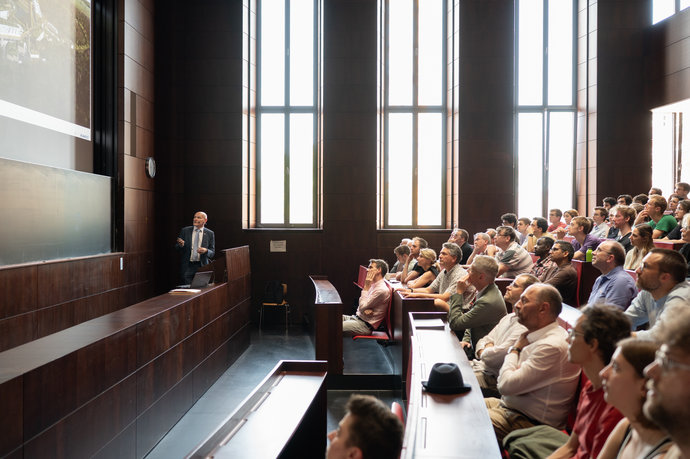
The Scientific Managing Director of GSI and FAIR, Professor Thomas Nilsson, will be even more closely involved in the scientific and research landscape in the region in future: He is an “Affiliate Professor” at TU Darmstadt and is now officially associated with the Department of Physics. TU Darmstadt recently awarded this academic title to an internationally outstanding scientific personality for the first time. The award was ...
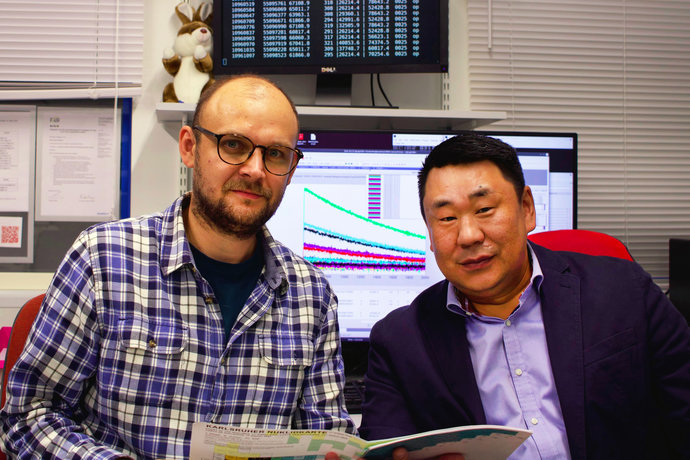
An international research team lead by GSI/FAIR, Johannes Gutenberg University Mainz (JGU) and Helmholtz Institute Mainz (HIM) has succeeded in the production of a new seaborgium isotope. In the experiment conducted at the GSI/FAIR accelerator facilities, 22 nuclei of seaborgium-257 could be detected. The results were published in the journal Physical Review Letters and highlighted as an “Editor’s Suggestion.”

Professor Marco Durante, Head of the Biophysics Department at GSI Helmholtzzentrum für Schwerionenforschung and Professor at the Department of Physics at TU Darmstadt, Institute of Condensed Matter Physics, has been granted a prestigious European Union research funding award for established scientists: The European Research Council (ERC) has awarded him the renowned Advanced Grant. The biophysicist will be able to use the millions in funding to realize an ambitious research project ...
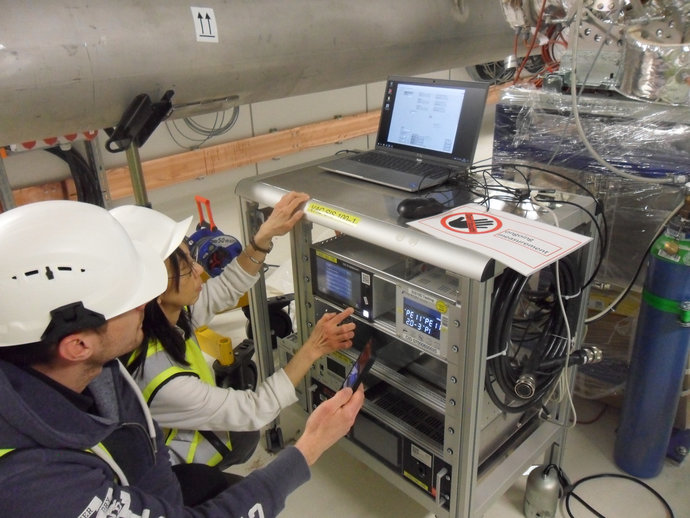
For the first time, the beam pipe of a section of the FAIR ring accelerator SIS100, operating at room temperature, has been pumped down to a high vacuum level (approx. 10-8 mbar). The commissioning of the vacuum systems serves the recording and analyzing of pump-down curves, as well as tests of the functionality of valves, pumps and vacuum gauges and the execution of leak checks.
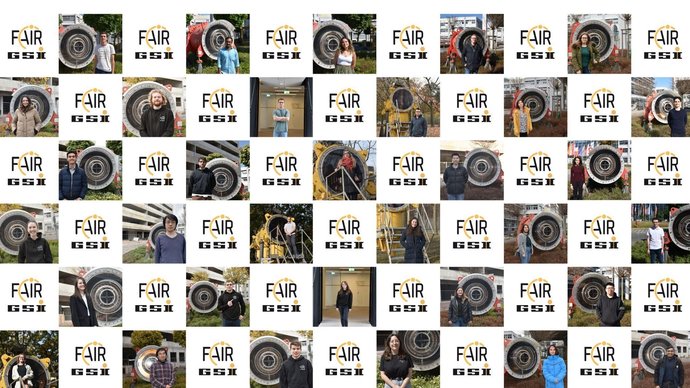
Since years, the GET_INvolved Program has been fostering young talent, combining talent scouting with structured administration, and ensuring impactful mentorship. Over the eight years of its existence, the program has grown steadily, setting new standards for young people and their career development in research and technology. Since its inception, the GET_INvolved Program has become an international attraction for young researchers and students. It successfully supports young talents on…


