


GSI/FAIR research: Innovative method opens up new paths for studying radioactive molecules
15.09.2026 |
An international research team led by the University of Edinburgh, in collaboration with researchers from GSI/FAIR, Justus Liebig University Gießen (JLU), and other partner institutions, has developed a new experimental approach to studying short-lived radioactive molecules. This work lays the cornerstone for a new generation of precision experiments capable of investigating fundamental questions in physics — ranging from the search for physics beyond the Standard Model, which summarizes the current state of knowledge in particle physics, to the chemistry of radioactive elements. The work was carried out as part of the Super-FRS Experiment Collaboration (SEC), which is part of the NUSTAR pillar at the future FAIR accelerator center currently under construction at GSI. The results have now been published in the journal “Nature Communications”.
The study focuses on a newly developed experimental method that allows radioactive molecular ions to be formed within a few milliseconds and analyzed with high precision. Among other things, the researchers were able to produce and characterize the formation of molecular radium fluoride (RaF⁺), polonium fluoride (PoF⁺), and lead fluoride (PbF⁺) ions.
All elements heavier than bismuth consist exclusively of radioactive isotopes and are available only in extremely small quantities. Until now, their study has been almost exclusively relied on production at large accelerator centers or research reactors. The newly developed method combines the collection (harvest) of decay products from radioactive sources in a high-purity gas cell with rapid in-trap ion-molecule reactions and high-resolution time-of-flight mass spectrometry. This makes it possible to study even isotopes with half-lives of only a few hundred milliseconds. Looking ahead, this opens up the possibility of systematically studying radioactive molecules in the future at universities and other research institutions complementing experiments at large accelerator facilities.
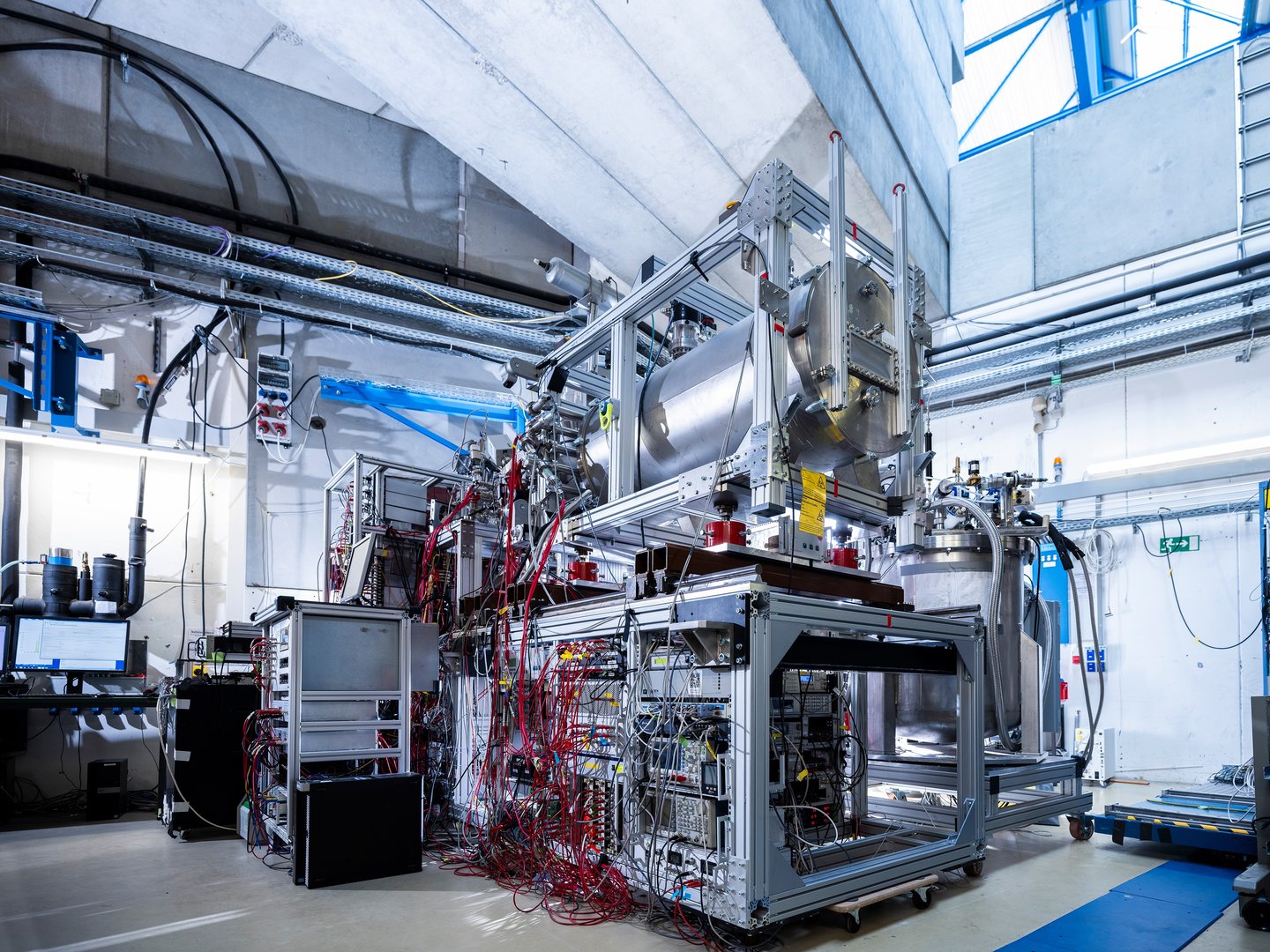
The experiments were conducted at GSI’s FRS Ion Catcher. The work now presented serves as an example of how close collaboration between universities and major research institutions can open up new fields of research, and how the cutting-edge technologies at GSI/FAIR could serve as a pioneering force for decentralized research at universities that do not have their own on-site accelerators.
At the University of Edinburgh, the RAFICI project (Radium Fluoride Ion Catcher Instrument) is working on developing a compact, cost-effective implementation of the concept suitable for university laboratories. Dr. Moritz Pascal Reiter, Reader at the University of Edinburgh, explains: “Radioactive molecules offer enormous potential for fundamental physics, but also for groundbreaking applications such as targeted cancer therapy. Until now, however, research in this area has been strictly limited to accelerator labs. We launched the RAFICI project with the goal of bringing radioactive molecules directly to the lab bench. The advanced technology of the FRS Ion Catcher was the key to successfully demonstrating this decentralized approach.” In the experiments at GSI, the researchers were able to show that they could generate even extremely short-lived radioactive molecular ions using a radioactive source. “This opens up a completely new avenue that provides laboratories worldwide with direct and straightforward access,” emphasizes Dr. Reiter.
The recently published paper also marks the start of a long-term research program. In the coming years, further experiments are planned — both with radioactive ion beams at GSI and the future FAIR facility, as well as beam-independent experiments using the new method, in which radioactive molecules will be used directly for chemical and physical investigations. Dr. Timo Dickel, head of the Thermalisated Exotic Nuclei group at GSI/FAIR, emphasizes: “At the FRS Ion Catcher, we are establishing a diverse long-term offline program that, among other things, enables the study of radioactive molecules independently of accelerator operations.” The goal is to establish systematic investigations of radioactive molecules and thereby create new opportunities for precision experiments, the search for new physics, and applications in radiochemistry and nuclear medicine. (BP)


