


Satellite assembly at GSI/FAIR – TRACE assembly completed in the Detector Laboratory

31.03.2026 |
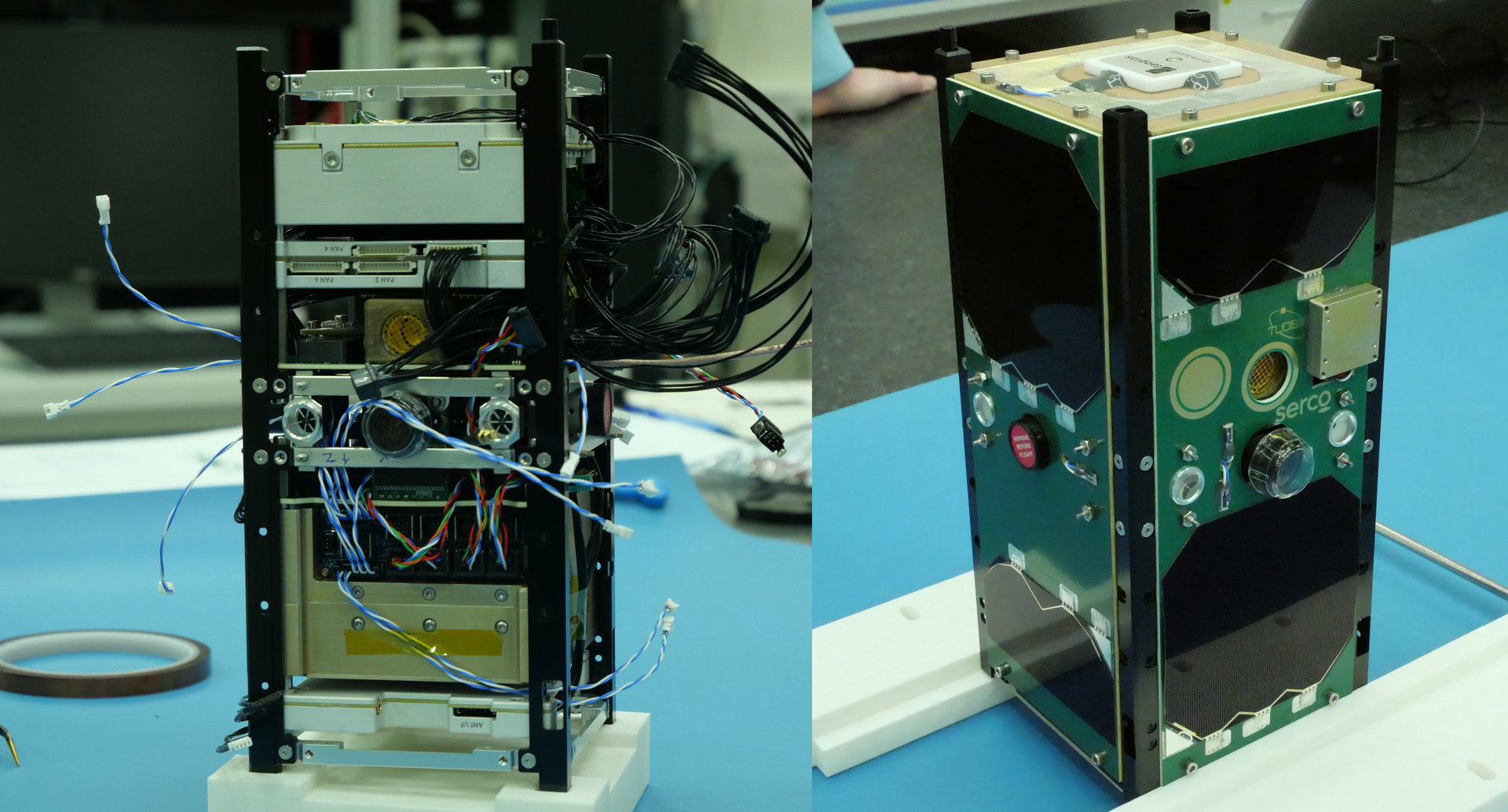
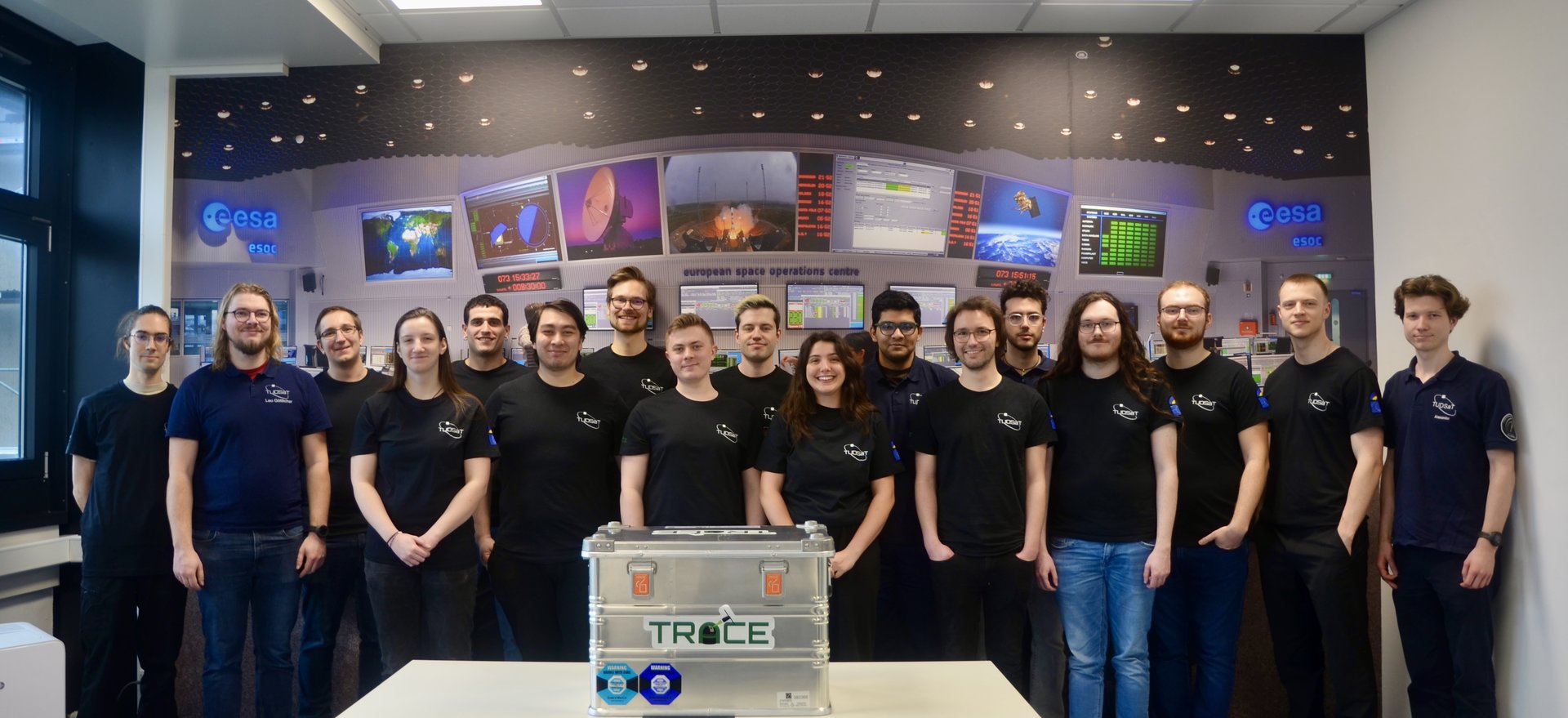
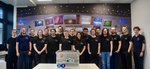
The student space association TU Darmstadt Space Technology e.V. (TUDSaT) has successfully completed the assembly of the TRACE satellite in the cleanroom environment of GSI/FAIR’s detector laboratory. The satellite also carries detectors from GSI/FAIR, which are designed to measure charged particles in orbit.
TRACE (TU Darmstadt ReseArch Cubesat for Education) is a student-developed satellite combining multiple scientific, technological, and educational missions. Based on current information, TRACE will be the first university satellite from Hesse to reach orbit, marking a significant milestone for Hesse as a hub for science and higher education.
The TRACE project was started in 2022, and the satellite design was finalized in 2024. In 2025, the intense phase of assembly and qualification activities began. During this period, all subsystems were procured, integrated, and functionally tested both individually and as a whole. The final assembly phase of the flight model took place between fall 2025 and January 2026. In a total of three assembly campaigns, the team integrated the purchased and in-house developed components in the cleanrooms of the GSI/FAIR Detector Laboratory. With the successful completion of this work, TRACE was finalized as a fully integrated satellite in January 2026.
In the Detector Laboratory usually detectors for the experiments at the accelerators of GSI and FAIR and at other particle accelerators in the world are produced. A cleanroom environment is available for detector construction, which also provided optimal conditions for the TRACE satellite assembly. In exchange, TRACE is sending two different detectors from GSI/FAIR into space to measure charged particles in orbit.
As the next step, TRACE undergoes a shaker and thermal vacuum acceptance test campaign at the European Space Agency (ESA). A potential launch of TRACE has already been funded by the European Commission as part of the European Flight Ticket Initiative, and the specific mission and launch opportunity are currently being coordinated. The launch is expected by 2027. After launch, TRACE will be operated entirely from its own satellite operations center at TU Darmstadt and via the association’s own ground station.
TRACE’s mission objectives include the validation of spin-in technologies, the testing of ground-based attitude determination using reflection pattern recognition, the measurement of charged particles and gamma radiation in Low Earth Orbit, a camera mission to capture images of Darmstadt from space, and the subsequent use of the satellite as an academic experimentation and teaching platform. A central focus of the project is also the practical teaching of skills in the areas of systems engineering, software development, and satellite operations to students.
TUDSaT is a non-profit association founded in 2016 and a university group at the Technical University of Darmstadt dedicated to promoting science, research, and education in the field of space technology. Among other things, the association aims to develop its own satellite, launch it into space, and operate it independently. Currently, TUDSaT has almost 300 students and alumni from a wide variety of disciplines. In addition to TRACE, the association runs the student rocket development team RAPID, supports courses, and is a co-founder of the Bundesverband studentischer Raumfahrt (BVSR), which represents the interests of all students in the German-speaking space sector toward politics and industry. (CP)


