


AI opens a new window into the hidden world of nuclear matter — GSI/FAIR participate in identification of hypernucleus
18.12.2025 |
Researchers from the High Energy Nuclear Physics Laboratory at the RIKEN Pioneering Research Institute (PRI) in Japan and their international collaborators, among them GSI/FAIR in Darmstadt, have achieved a groundbreaking discovery that bridges artificial intelligence and nuclear physics. By applying deep learning techniques, the team identified, for the first time in 25 years, a new double-Lambda hypernucleus. This marks the world’s first AI-assisted observation of such an exotic nucleus — an atomic nucleus containing two strange quarks. The findings, published in Nature Communications, represent a major advance in experimental nuclear physics and provide new insights into the composition of neutron stars, one of the most extreme environments in the universe.
Matter is composed of atoms, whose nuclei consist of protons and neutrons. These particles, known as hadrons, are made of more fundamental building blocks called quarks. A strong nuclear force binds hadrons together, maintaining a delicate balance that both binds them together and keeps them far enough apart to prevent collapse. Understanding the origin of this force is crucial to explaining how matter and the universe were initially formed.
To probe this force, scientists study hypernuclei — atomic nuclei that contain strange quarks. These nuclear building blocks are also called Lambda particles. In extremely rare cases, two strange quarks can be bound within the same nucleus, forming a double-Lambda hypernucleus. These systems allow researchers to directly measure the interaction between the two Lambda particles and to explore how the nuclear force behaves when strange quarks are involved. This knowledge is also essential for understanding the properties of matter under the extreme densities found in neutron stars, where hyperons are expected to exist.
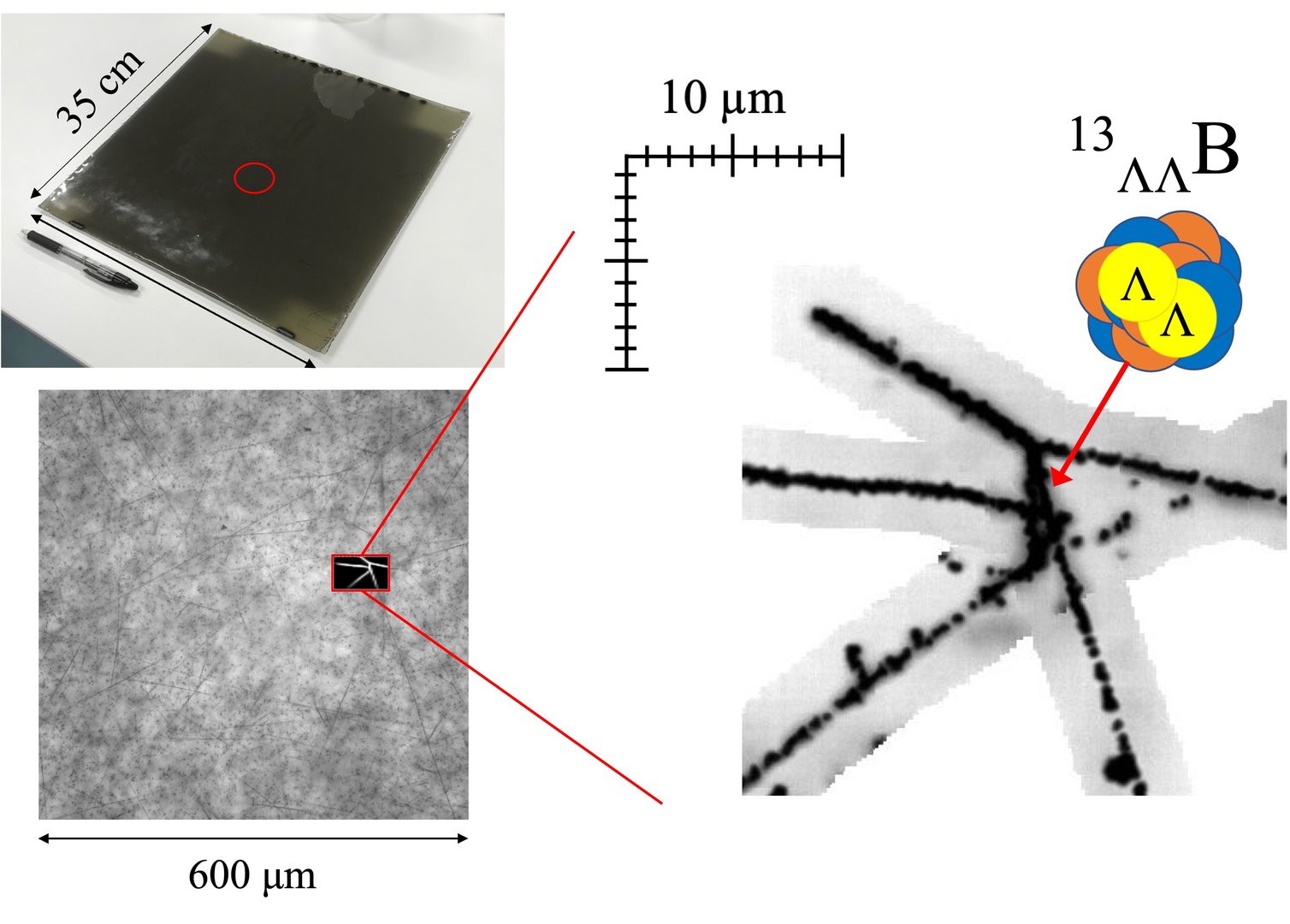
Detecting double-Lambda hypernuclei has long been a major challenge because they are produced very rarely and exhibit complex decay structures. In the J-PARC E07 experiment, nuclear emulsion plates recorded the tracks of particles resulting from hypernuclear formation and decay. However, only a very small fraction of the emulsion data has been analyzed because conventional methods are time and labor consuming. As a result, a vast amount of valuable information remains unexplored.
The RIKEN-led team developed a deep-learning–based analysis framework to process this enormous dataset. By training neural networks to recognize the subtle signatures of double-strangeness events, the researchers were able to automatically extract candidate images indicating the potential formation and decay of double-Lambda hypernuclei. These images were then examined under a microscope. Through detailed kinematic analysis, one event was confirmed as the production of a double-Lambda hypernucleus of boron-13 (13ΛΛB), in which two Lambda particles are bound to a boron-11 nucleus. This identification is only the second unambiguous observation of a double-Lambda hypernucleus in history and the first such discovery in nearly 25 years. Moreover, it is the first time that the interaction between two Lambda particles has been measured in a nucleus other than helium.
This breakthrough was achieved by analyzing just 0.2 percent of the total emulsion data from the experiment. Based on this detection rate, the researchers estimate that the full dataset could contain more than 2,000 double-strangeness events awaiting discovery. The team plans to continue refining their deep learning–based analysis methods and to extend their search to reveal the behavior of Lambda particles in other hypernuclei.
Professor Takehiko Saito, head of the research group for the investigation of hypernuclei at GSI/FAIR and chief scientist of the RIKEN-PRI High Energy Nuclear Physics Laboratory, explains, “This achievement demonstrates how artificial intelligence can uncover extremely rare phenomena hidden within massive experimental datasets, revealing events that would be nearly impossible to find by human inspection alone. We believe that this approach will open the door to large-scale discoveries of double-Lambda hypernuclei and deepen our understanding of the nuclear force and the structure of matter in the universe.”
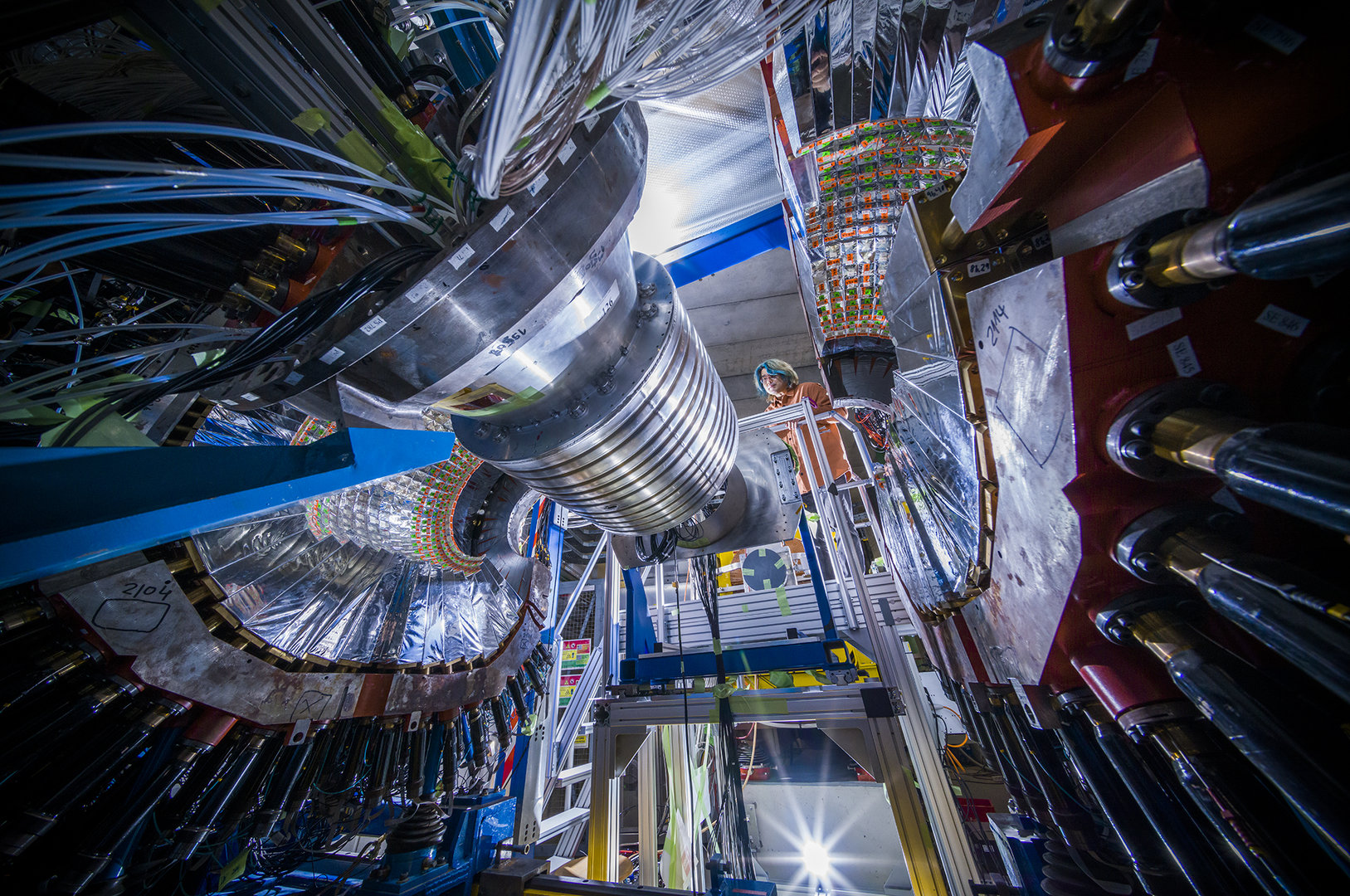
As part of the experiments at the fragment separator FRS, GSI/FAIR has been cooperating with international partners in the research field of hypernuclei for many years. At the new particle accelerator FAIR (Facility for Antiproton and Ion Research), currently under construction at GSI, further experiments on hypernuclei are foreseen. The current results provide important fundamental data for their realization. (CP)


