


ALICE solves mystery of production and survival of light nuclei – Contributions from GSI/FAIR researchers
16.12.2025 |
This news is based on a release by CERN
Particle collisions at the Large Hadron Collider (LHC) of the European research center CERN create tiny fireballs 100 thousand times hotter than the center of the Sun. The fireballs decay into new, sometimes quite exotic, particles including light atomic nuclei and their antimatter counterparts. Paradoxically, these can be created in - and escape from - the hot and dense environment unscathed even though the bonds holding their constituents together are very feeble. Physicists have puzzled over these "snowballs in hell" for decades, but now the ALICE collaboration has provided an explanation - described in a significant article recently published in the journal Nature. Scientists from GSI/FAIR are also involved.
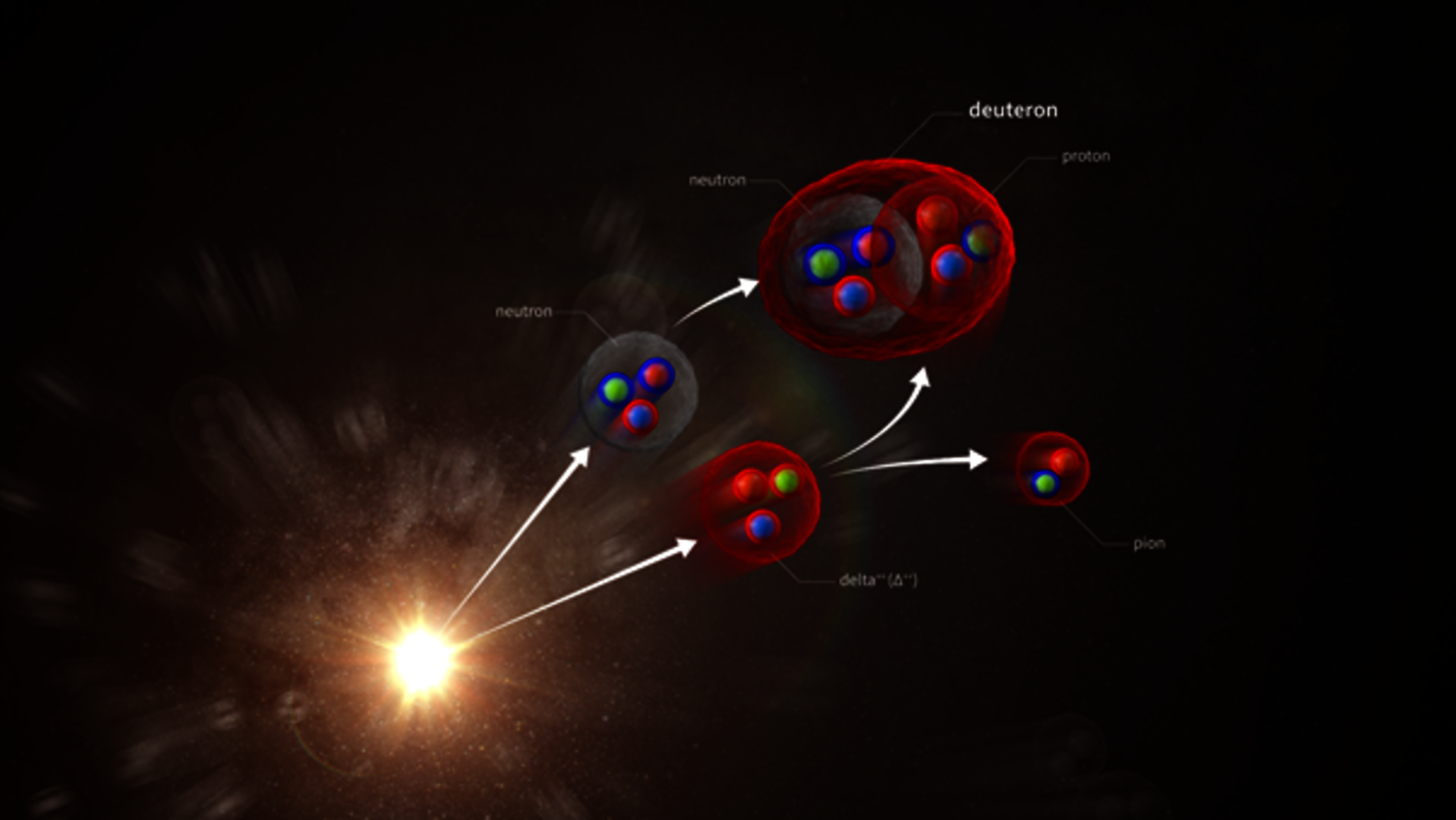
Researchers at ALICE studied deuterons (a proton and a neutron loosely bound together) that are produced in high-energy collisions of protons at the LHC. They found that deuterons are created at the latest stage of the collision, at a relatively low temperature, by nuclear fusion between the emerging protons and neutrons. Furthermore, in 90 percent of the cases either the proton or the neutron originates from the decay of a short-lived particle called delta resonance.
The delta resonance decays into a proton (or neutron) and a pion, the latter being a light particle composed of a quark and an antiquark. The decay products move apart with a characteristic velocity, determined by the delta's mass and the law of energy conservation. In the experiment, the observed deuteron–pion pairs exhibited relative velocities consistent with those expected from delta decays.
The picture is thus as follows. The fireball created in the collision is expanding and cooling down. In the final stage, there are pions, Delta resonances, protons, and neutrons loosely distributed in space. A decaying delta resonance gently sends a proton towards a flying-by neutron, and the pion from the same decay carries away the excess energy. This way the pion catalyzes the fusion of the proton and the neutron to a deuteron. The analysis was performed for both particles and antiparticles, confirming that the same mechanism governs the formation of deuterons and antideuterons.
“These results represent a milestone for the field,” said Dr. Marco van Leeuwen, ALICE spokesperson. “They fill a major gap in our understanding of how nuclei are formed from quarks and gluons and provide essential input for the next generation of theoretical models.”
The findings not only explain a long-standing puzzle in nuclear physics but could have far-reaching implications for astrophysics and cosmology. Light nuclei and antinuclei are also produced in interactions between cosmic rays and the interstellar medium, and theymay be created in processes involving the dark matter that pervades the Universe. By building reliable models for the production of light nuclei and antinuclei, physicists can better interpret cosmic-ray data and look for possible dark-matter signals.
The charged particles used for this analysis were measured with the Time Projection Chamber (TPC), the main tracking and particle-identification detector of the ALICE experiment. The TPC was built, calibrated, and operated with a leading contribution by the GSI Helmholtzzentrum für Schwerionenforschung in Darmstadt. "The pion assists the fusion of the proton and neutron, playing the role of the `best man' at their wedding" says Professor Silvia Masciocchi, the leader of the ALICE team at GSI/FAIR. "Once again ALICE demonstrates its unique versatility and precision in the demanding measurements of particles and their correlations at the LHC". (ALICE/BP)
Weitere Informationen
Publication in the journal "Nature"


