


JUNO completes liquid filling and begins data taking: New type of detector enables deeper understanding of the universe

29.08.2025 |
This news is based on a press release of the JUNO collaboration
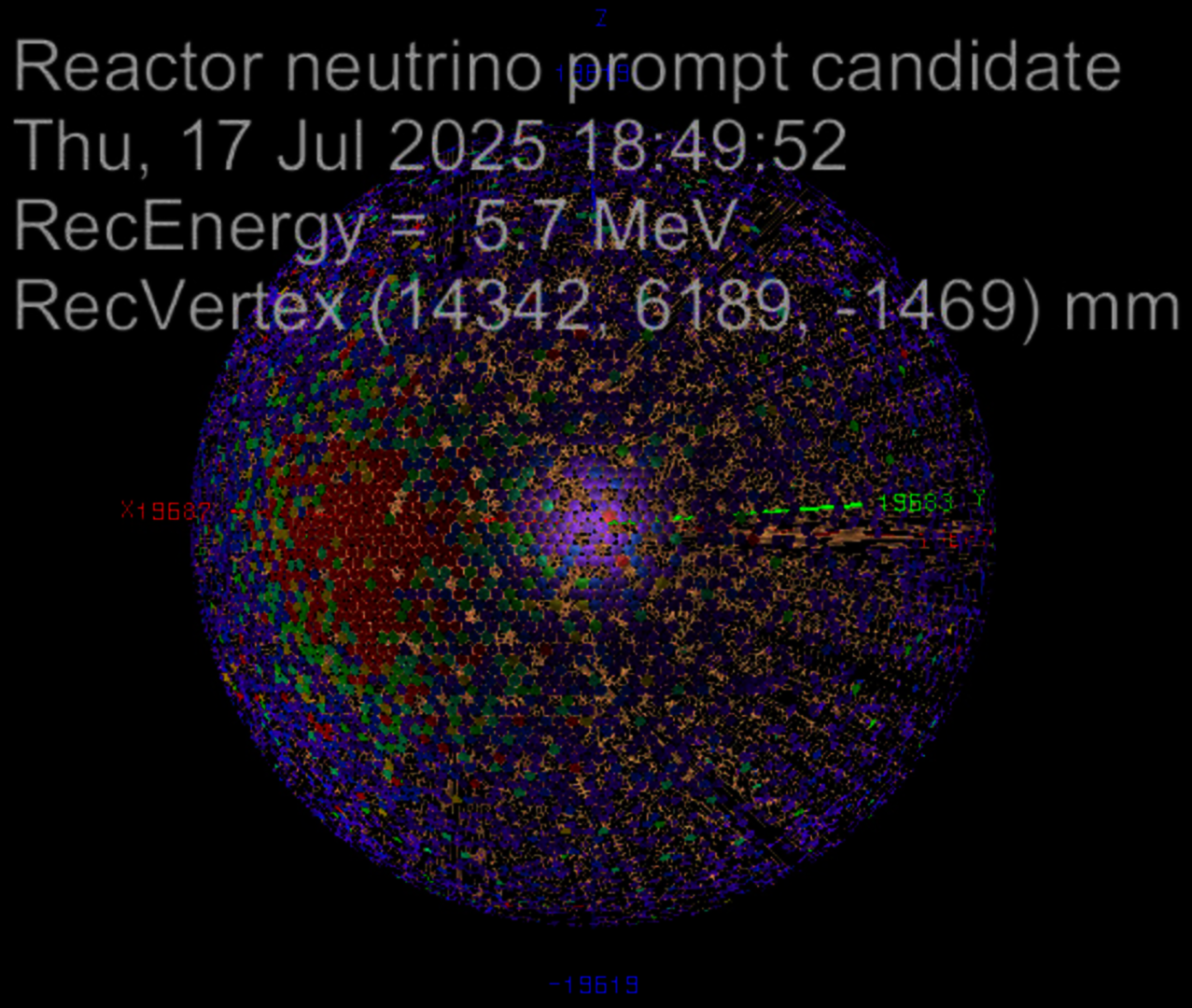
The Jiangmen Underground Neutrino Observatory (JUNO) near Jiangmen city in China has successfully completed the filling of 20,000 tons of liquid scintillator and begun data taking. After more than a decade of preparation and construction, JUNO is the first of a new generation of very large neutrino experiments to reach this stage. Livia Ludhova, professor of experimental neutrino physics at Johannes Gutenberg University Mainz and head of the neutrino group at GSI Helmholtzzentrum für Schwerionenforschung Darmstadt, is member of the JUNO Executive Committee. Her research group is now focusing on understanding the first commissioning data.
Initial trial operation shows that the new detector’s key performance specifications meet or exceed design requirements, enabling JUNO to tackle one of this decade’s major questions in particle physics: the ordering of neutrino masses—whether the third mass state (ν₃) is heavier than the second (ν₂). Professor Yifang Wang, a researcher at the Institute of High Energy Physics (IHEP) of the Chinese Academy of Sciences and JUNO spokesperson, said: “Completing the filling of the JUNO detector and starting data taking marks a historic milestone. For the first time, we have in operation a detector of this scale and precision dedicated to neutrinos. JUNO will allow us to answer fundamental questions about the nature of matter and the universe.”
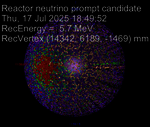
Located 700 meters underground in Jiangmen, Guangdong Province, JUNO detects antineutrinos produced 53 kilometers away by the Taishan and Yangjiang nuclear power plants and measures their energy spectrum with record precision. Unlike other approaches, JUNO’s determination of the neutrino mass ordering is independent of matter effects in the Earth and largely free of parameter degeneracies. JUNO will also deliver order‑of‑magnitude improvements in the precision of several neutrino‑oscillation parameters and pursue cutting‑edge studies of supernova and solar neutrinos, geoneutrinos, and searches for sterile neutrinos and proton decay.
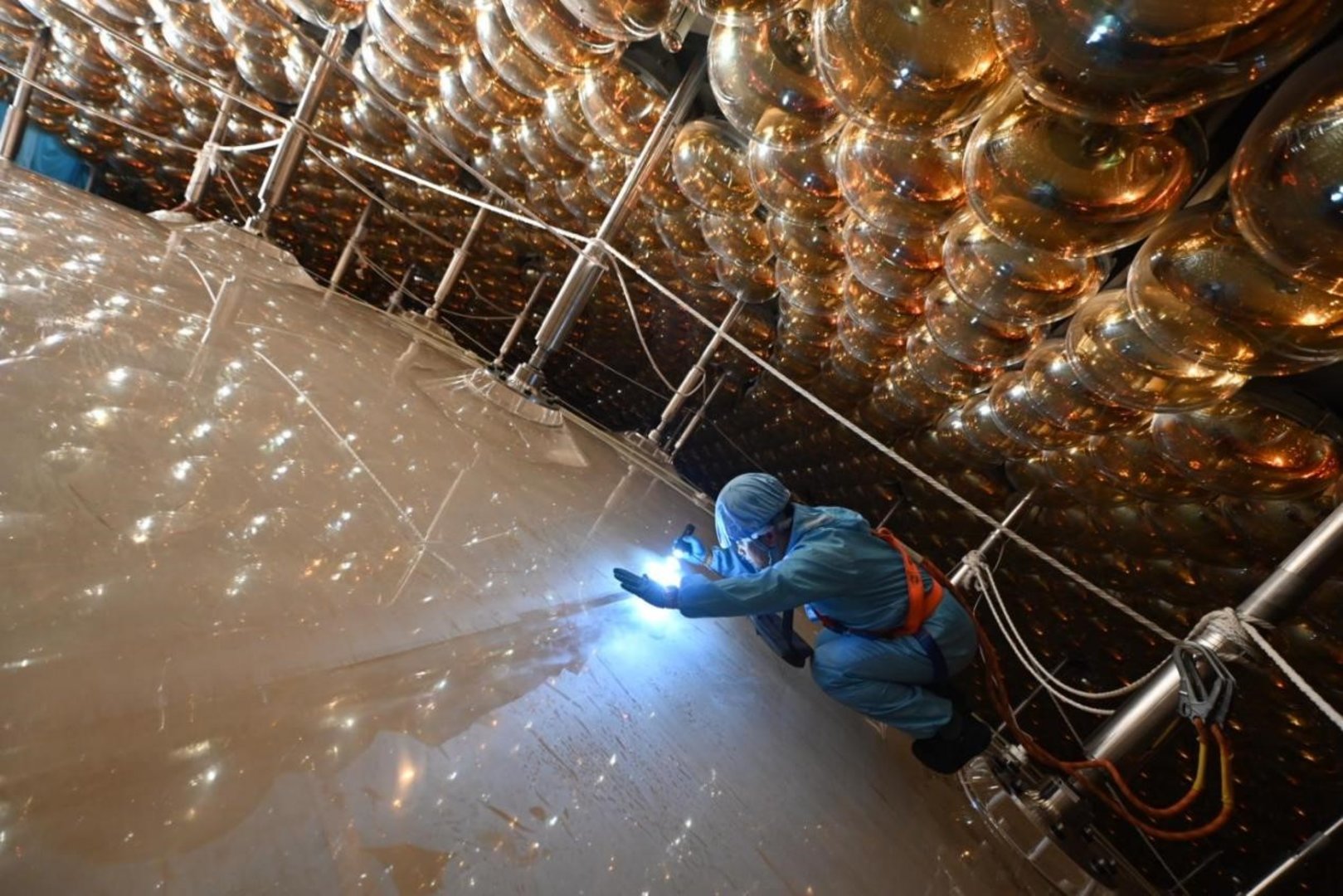
Proposed in 2008 and approved by the Chinese Academy of Sciences and Guangdong Province in 2013, JUNO began underground construction in 2015. Detector installation started in December 2021 and was completed in December 2024, followed by a phased filling campaign. Within 45 days, the team filled 60,000 tonnes of ultra‑pure water, keeping the liquid‑level difference between the inner and outer acrylic spheres within centimeters and maintaining a flow‑rate uncertainty below 0.5%, safeguarding structural integrity. Over the next six months, 20,000 tonnes of liquid scintillator were filled into the 35.4‑meter‑diameter acrylic sphere while displacing the water. Throughout, stringent requirements on ultra‑high purity, optical transparency, and extremely low radioactivity were achieved for both media. In parallel, the collaboration conducted detector debugging, commissioning, and optimization, enabling a seamless transition to full operations at the completion of filling.
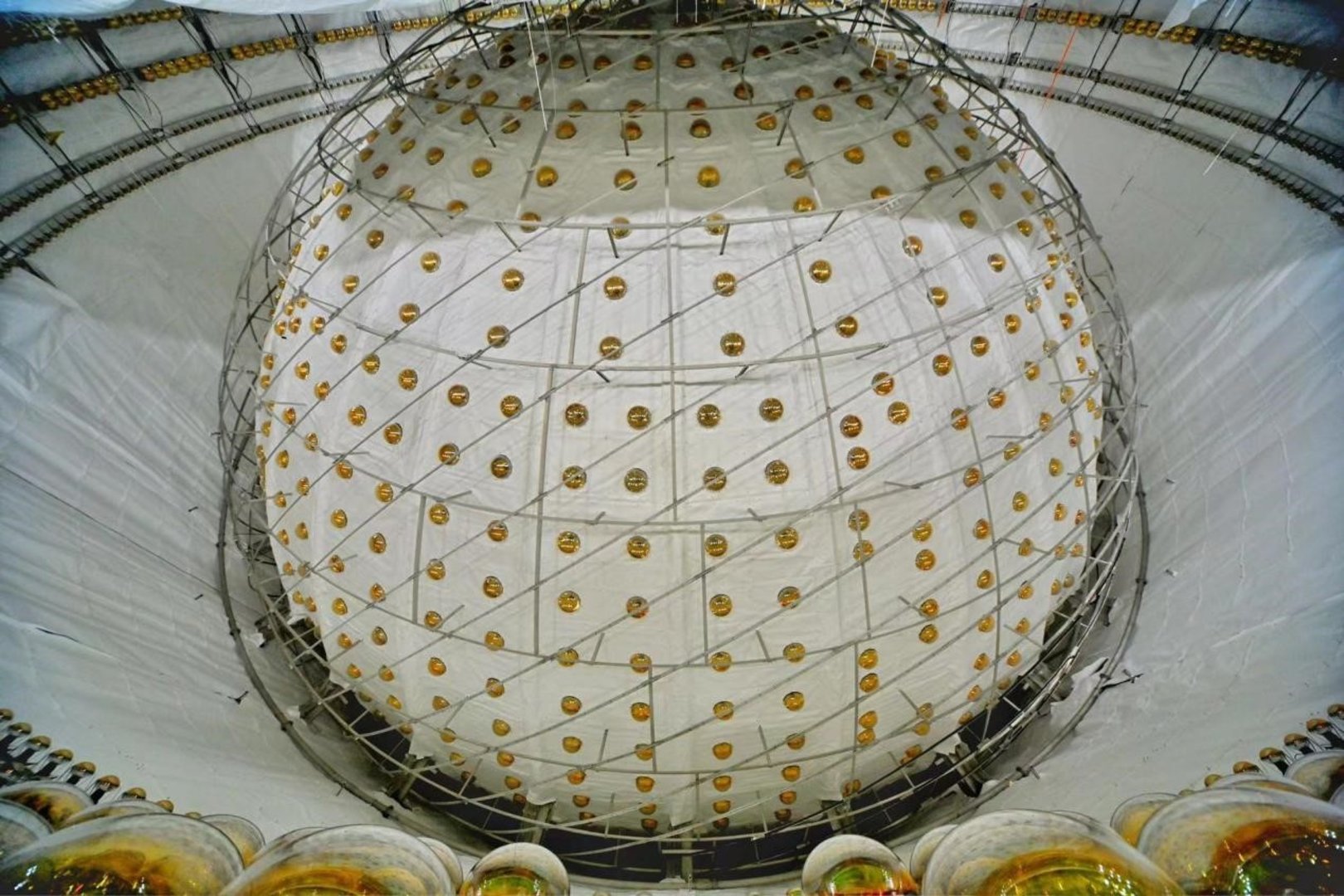
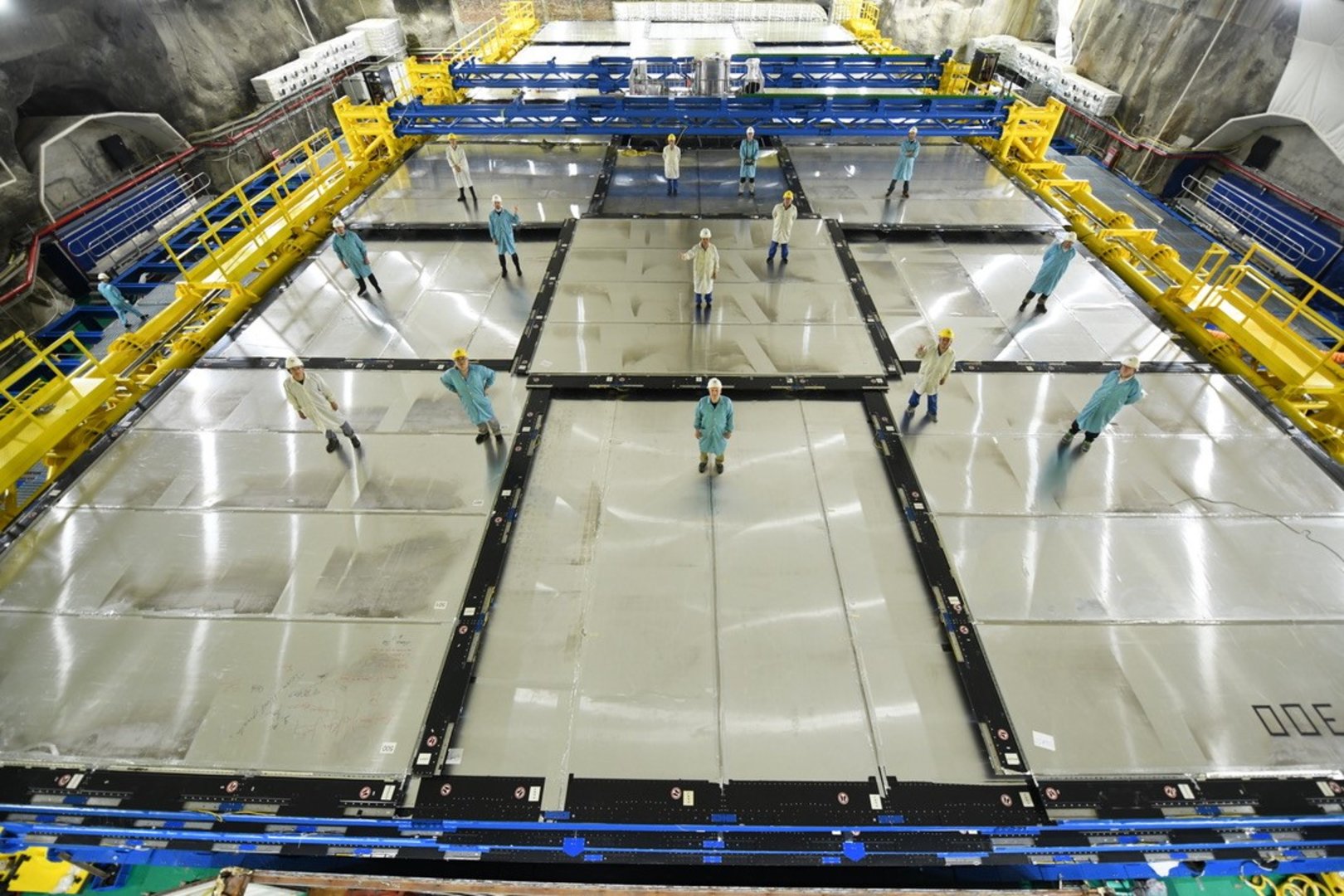
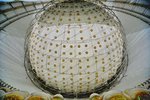
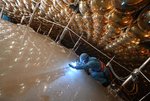
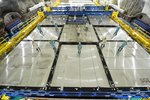
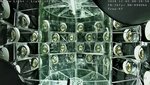
At the heart of JUNO is a central liquid‑scintillator detector (effective mass 20.000 tons) at the center of a 44‑meter‑deep water pool. A 41.1‑meter‑diameter stainless‑steel lattice shell supports the 35.4‑meter acrylic sphere, the scintillator, 20.000 20‑inch photomultiplier tubes (PMTs), 25.600 3‑inch PMTs, front‑end electronics, cabling, anti‑magnetic compensation coils, and optical panels. All PMTs operate simultaneously to capture scintillation light from neutrino interactions and convert it to electrical signals.
During construction, the collaboration realized several technological breakthroughs, including high-performance large-area PMTs with innovative structural and amplification designs; an underwater explosion-mitigation and waterproofing system to protect PMTs; and a high-purity, high-throughput scintillator purification system yielding attenuation lengths exceeding 20 meters. With novel underwater electronics, JUNO achieved high reliability using commercially available components, enhancing robustness while reducing cost.
Dr. Xiaoyan Ma, JUNO Chief Engineer, remarked: “Building JUNO has been a journey of extraordinary challenges. It demanded not only new ideas and technologies, but also years of careful planning, testing, and perseverance. Meeting the stringent requirements of purity, stability, and safety called for the dedication of hundreds of engineers and technicians. Their teamwork and integrity turned a bold design into a functioning detector, ready now to open a new window on the neutrino world.”
JUNO is hosted by the IHEP and involves more than 700 researchers from 74 institutions across 17 countries and regions. Six research groups from Germany – with support from the German Research Foundation (DFG) – participated in the experiment, including the working groups of Professor Michael Wurm and Professor Livia Ludhova at Johannes Gutenberg University Mainz, which belong to the PRISMA+ Cluster of Excellence.
Professor Ludhova from GSI and JGU says, “JUNO is the result of many years of international collaboration. Our teams have contributed important building blocks to the current success: with the OSIRIS pre-detector to ensure the radioactive purity of the scintillator during detector filling, with studies on sensitivity, and with the analysis of the first data now taken during commissioning, all in close collaboration with our colleagues in China. It is very satisfying to see how our combined expertise has now come together in a detector that will serve the global physics community for decades.”
JUNO is designed for a scientific lifetime of up to 30 years, with a credible upgrade path toward a world‑leading search for neutrinoless double‑beta decay. Such an upgrade would probe the absolute neutrino mass scale and test whether neutrinos are Majorana particles, addressing fundamental questions spanning particle physics, astrophysics, and cosmology. (BP)


