


Open-access biography “Hans Joachim Specht — Scientist and Visionary” published
Celebrating a legacy of discovery, leadership, and lasting impact
13.08.2025 |
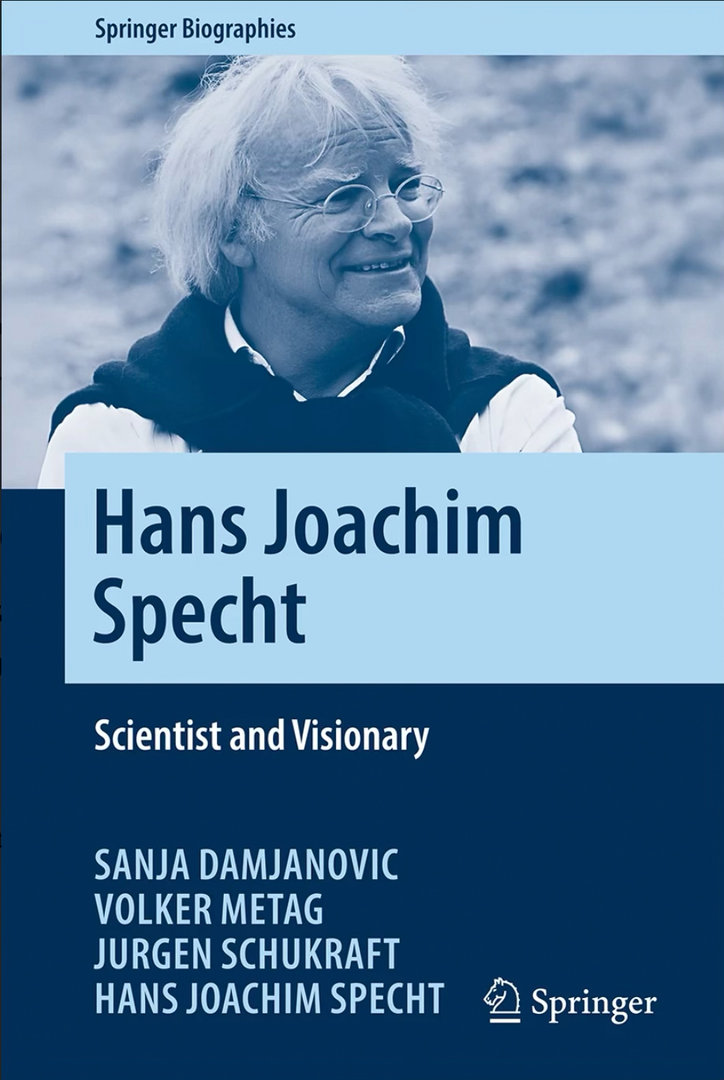
The new open-access volume “Hans Joachim Specht — Scientist and Visionary”, published in July 2025 by Springer, honors the life and work of Professor Hans Joachim Specht, who passed away in May 2024 at the age of 87. By tracing Specht’s scientific career and leadership role, it offers an insightful portrait of a physicist who profoundly shaped both the scientific agenda and institutional landscape of modern nuclear and heavy-ion physics in Europe.
The biography is introduced with a foreword by Nobel laureate Carlo Rubbia and features contributions from Specht himself and many of his closest collaborators and scientific peers — including Peter Armbruster, Sanja Damjanovic, Jürgen Debus, Axel Drees, Hartmut Eickhoff, Klaus-Dieter Groß, Dietrich von Harrach, Volker Metag, Shoji Nagamiya, Helmut Satz, Jürgen Schukraft, and others. Together, their reflections offer a rich tapestry of personal memories and historical perspectives — providing context not only for the past, but also for the present and future of nuclear and particle physics in Europe.
Spanning more than six decades of groundbreaking research and leadership, the volume presents a vivid chronicle of Specht’s evolving scientific work at Munich, Heidelberg, CERN, GSI, and beyond. From early discoveries in atomic physics and nuclear fission to pioneering contributions in ultra-relativistic heavy-ion physics, Specht was a driving force at the forefront of experimental science and collaboration.
As Scientific Managing Director of the former Gesellschaft für Schwerionenforschung, today GSI Helmholtzzentrum für Schwerionenforschung, in the years from 1992 to 1999, Specht was instrumental in expanding GSI’s mission into applied research — particularly ion-based cancer therapy and plasma physics — while preserving its core focus on fundamental science. He played a pivotal role in establishing Europe’s first clinical ion-beam cancer therapy program using carbon ions. The successful treatment of the first 440 patients at GSI marked a milestone in medical physics and laid the groundwork for Heidelberger Ionenstrahl-Therapiezentrum (HIT), Europe’s first hospital-based hadron therapy center.
Beyond his scientific achievements, Specht was a leading figure in planning and promoting new instrumental developments, experimental programs and research facilities. He contributed to the early vision for FAIR thus shaping the long-term future of GSI, initiated plasma physics programs, and advanced detector technologies whose influence extended well beyond CERN and GSI.
From the early 1980s to 2010, Specht played leading roles in four major CERN experiments — R807/808 at the ISR, HELIOS, CERES/NA45, and NA60 at the SPS — contributing not only to their scientific objectives but also to their technical realization and strategic direction.
At Heidelberg University, he established a leading heavy-ion research group and was a key advocate in securing Germany’s support for the heavy-ion program at CERN through the BMBF.
Specht’s foundational contributions to the ALICE experiment were instrumental. His role in developing the conceptual design for a dedicated LHC heavy-ion experiment helped transform the vision of heavy-ion physics at the LHC into reality. As a convener within the European Committee for Future Accelerators (ECFA), his leadership and tireless advocacy for institutional backing from Germany were significant for shaping ALICE into one of CERN’s flagship experiments.
Combining rigorous documentations with heartfelt recollection, the volume offers valuable perspectives for both experienced physicists and younger researchers seeking to understand the historical foundations of today’s experimental infrastructures.
At its core, the book is a powerful reminder that scientific progress depends not only on great ideas and scientific excellence, but also on visionary leadership, timing, and institutional foresight. In this sense, it is a lasting tribute to an outstanding scientist whose vision, integrity, and passion for diversity continue to inspire. (CP)


